
Stinging Nettle
Urtica dioica
Stinging nettle is a familiar wild plant found in gardens, hedgerows, woodland edges and other nutrient-rich places. Although its stinging hairs make it rather unpopular, properly prepared young nettles are a versatile wild vegetable with a long history as food, herbal preparation, fibre plant and wildlife habitat.
The young leaves and tender tops can be eaten after they have been thoroughly cooked, blanched or dried. Always identify the plant with complete confidence, wear gloves while harvesting and never eat fresh nettle leaves raw.
Harvesting Period
Young leaves: spring to early summer
Seeds: late summer to autumn
Fresh regrowth may appear after cutting
Habitat
Nutrient-rich soil in hedgerows, woodland edges, riverbanks, gardens and disturbed ground
Height
Usually 50–150 centimetres
Occasionally up to 2 metres
Usable Parts
Young leaves, tender tops and mature seeds
Roots are not an ordinary food ingredient
Stinging nettle is a herbaceous perennial in the nettle family, Urticaceae. Its underground rhizomes allow it to return every spring and spread into substantial patches.
Nettles are often associated with disturbed and nitrogen-rich ground, but they are much more than garden weeds. They provide food and shelter for numerous insects, while their young leaves have been gathered as spring greens for generations.
Identification
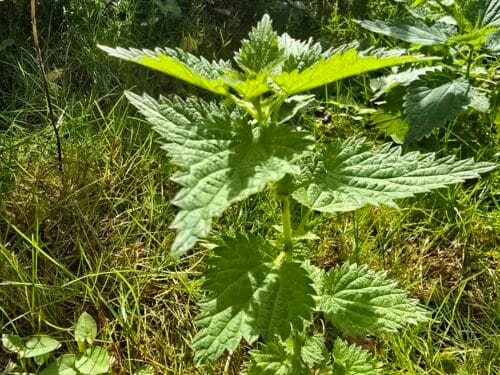
Stinging nettle has upright green stems that are usually unbranched below the flowering section. The stems are ridged or grooved and covered with a mixture of ordinary bristles and fine stinging hairs.
The leaves grow in opposite pairs along the stem. They are dark green, pointed and broadly oval to lance-shaped, often with a heart-shaped base. Each leaf has a sharply toothed margin and several prominent veins running upwards from near the base.
Both the leaves and stems carry brittle stinging hairs. When touched, the tips of these hairs can break and release irritating substances into the skin, causing an immediate burning, itching or prickling sensation.
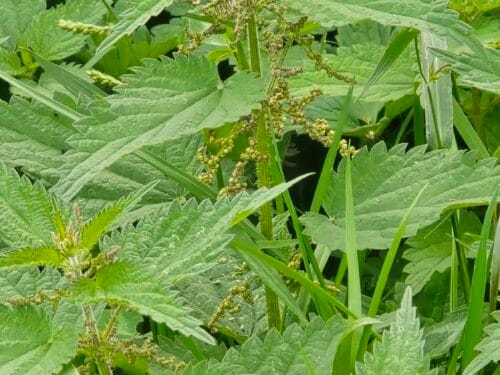
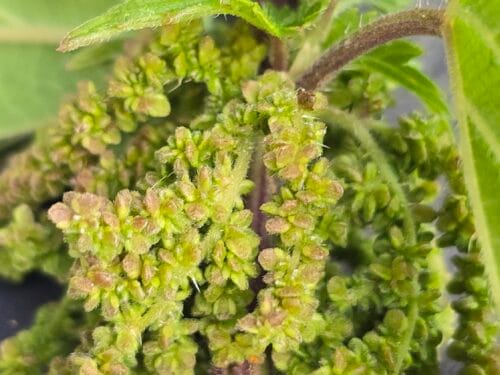
From late spring into autumn, small greenish flowers appear in branching clusters from the leaf axils. Stinging nettle commonly has male and female flowers on separate plants. The female flower clusters generally hang down as they develop, while male clusters are often more spreading.
After flowering, the female plants produce many tiny, flattened seeds. The plant dies back above ground during winter and grows again from its underground rhizomes in spring.
Possible Lookalikes
Several plants have leaves resembling those of stinging nettle. The presence of genuine stinging hairs is an important clue, but identification should never depend on deliberately touching an unknown plant.
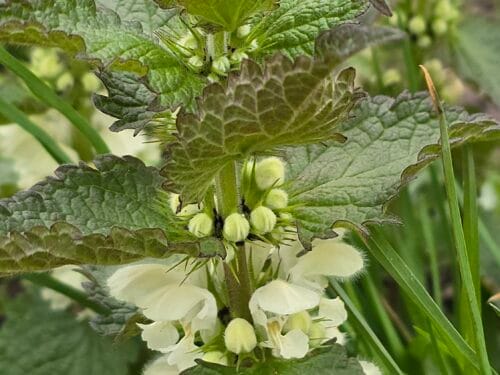
White Dead-nettle – Lamium album
White dead-nettle has opposite, toothed leaves but does not sting. It has distinctly square stems and produces conspicuous white, two-lipped flowers arranged around the upper part of the stem.
White dead-nettle is edible when correctly identified, but it belongs to the mint family and is not a true nettle.
Red Dead-nettle – Lamium purpureum
Red dead-nettle is usually much smaller than mature stinging nettle. Its upper leaves often develop a purple or reddish colour, and it produces small pink-purple flowers.
Its stem is square and its leaves feel soft rather than carrying the characteristic brittle stinging hairs of Urtica dioica.
Hemp-nettle – Galeopsis species
Hemp-nettles have opposite, toothed leaves and hairy square stems. Their stems commonly have swollen sections around the leaf nodes, and their flowers are noticeably larger and more colourful than nettle flowers.
Some hairs may feel rough or bristly, but they do not produce the typical nettle sting. Do not use hemp-nettle as a substitute unless you have confidently identified the exact species.
Small Nettle – Urtica urens
Small nettle is another true stinging nettle. It is normally smaller, more compact and annual rather than perennial. Its leaves are shorter and more rounded, with deeply toothed edges.
Small nettle also stings and has a history of similar food use after proper preparation. Nevertheless, learn to distinguish it from Urtica dioica rather than assuming that every stinging plant is the same species.
Edible
Young stinging-nettle leaves have a green, earthy flavour that is sometimes compared with spinach. Choose clean, healthy top shoots before the plants become tough and fibrous.
Wear gloves and use scissors to harvest the tender upper section. Wash the leaves carefully and always cook, blanch or thoroughly dry them before use. Heat and complete drying disable the stinging hairs.
Fresh raw nettle leaves should not be eaten. Simply chopping or blending them does not always guarantee that every stinging hair has been neutralised.
Young nettle leaves can be used in:
Soups, broths and stews
Cooked wild greens
Risotto and savoury rice dishes
Pasta fillings and sauces
Omelettes, quiches and savoury bakes
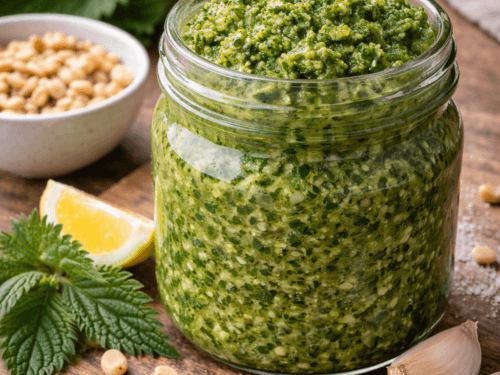
Pesto after blanching
Bread, crackers and savoury pancakes
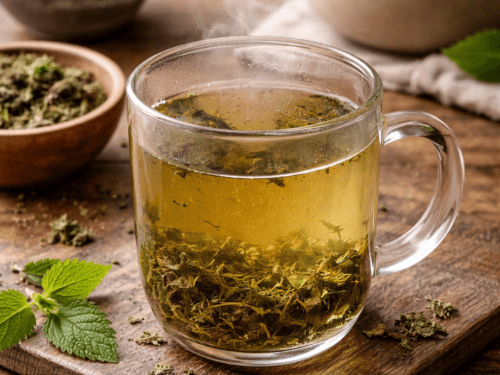
Herbal infusions made from properly dried leaves
Dried green powder used in modest culinary quantities
The tiny seeds can be collected from mature female plants in late summer or autumn. Separate them carefully from insects and plant debris before culinary use. Nettle seeds have a long history of traditional use and are sometimes described as restorative or energising. These descriptions belong to herbal tradition and should not be interpreted as proven medical effects.
Specific Warning for Stinging Nettle
Wear gloves and preferably long sleeves while harvesting. The stinging hairs can cause painful irritation and should be kept away from the eyes and face.
Only gather nettles from clean locations. Avoid roadsides, sprayed ground, dog-walking routes, polluted riverbanks, sewage-contaminated areas and places where manure or other contaminants may have accumulated.
Inspect every leaf carefully. Nettles are important host plants for several butterflies, and leaves may carry eggs, caterpillars or silk-covered nests. Leave occupied plants completely undisturbed.
Wash the harvested leaves thoroughly and cook, blanch or completely dry them before consumption. Young leaves are generally preferred because older leaves and stems become increasingly coarse and fibrous.
Food allergies and individual sensitivities are possible. Try only a small quantity the first time you eat a correctly identified wild plant.
Concentrated nettle preparations are not the same as eating an occasional portion of cooked leaves. Anyone who is pregnant, breastfeeding, taking medication or living with a kidney, heart, blood-pressure or blood-sugar condition should obtain qualified medical advice before using nettle regularly as a medicinal preparation.
Medicinal nettle products intended to increase urine production are unsuitable when a doctor has advised restricted fluid intake because of serious heart or kidney problems.
Nettle root has different constituents and traditional applications from nettle leaf and herb. Do not casually add the root to food or homemade tea, and do not use it to self-treat urinary symptoms. Persistent urinary symptoms require medical assessment.
Responsible Harvesting
Choose a large, healthy nettle patch away from contamination. Wear gloves and cut only the tender top 10–15 centimetres, or approximately the upper four to six leaves, from each plant.
Harvest lightly from several plants instead of stripping one plant completely. Leave plenty of stems to flower, produce seed and continue supporting local wildlife.
Nettles are valuable host plants for the caterpillars of butterflies including the peacock, small tortoiseshell, red admiral and comma. Check both sides of the leaves for eggs, caterpillars, webbing and feeding damage before harvesting.
Do not remove an entire patch. Dense nettle colonies provide cover and food for insects and contribute to the ecology of hedgerows, woodland edges and riverbanks.
Traditional Use
Stinging nettle has been used for food, fibre and household preparations for centuries. These uses form part of traditional knowledge and should be described as history rather than as a guarantee of medical effectiveness.
Traditional applications of the leaves and aerial parts include:
- Cooked spring greens, soups and broths
- Herbal teas and seasonal “spring tonic” preparations
- Preparations intended to support urinary flow
- Traditional remedies for minor joint discomfort
- Hair rinses and scalp preparations
- Green and yellow plant dyes
- Animal fodder after wilting or drying
- Nettle beer and other fermented drinks
- Compost activators and liquid plant feeds
The European Medicines Agency recognises long-standing traditional medicinal use of nettle herb for certain minor urinary complaints and minor articular pain. This classification is based on traditional use and does not mean nettle should replace diagnosis or medical treatment.
Nettle root has a separate history of use in herbal products for lower urinary tract symptoms associated with benign prostate enlargement. Such symptoms may have other causes, so nettle root should not be used for self-diagnosis or as a substitute for professional assessment.
Nettle stems also supplied strong fibres for cord, fishing nets, cloth and other textiles. This practical use was once nearly as important as the plant’s role as food.
Plant Compounds
Stinging-nettle leaves contain chlorophyll, carotenoids, flavonoids, phenolic acids, fibre and minerals. They also contain protein and various vitamins, although their exact nutritional composition varies with soil, season, age, processing and preparation.
Compounds reported in nettle leaf include rutin and several quercetin derivatives. These substances are frequently studied, but their presence alone does not prove that eating nettles can prevent or cure disease.
The stinging hairs contain irritant substances that produce the plant’s familiar burning sensation. Heating, blanching and thorough drying physically disable these hairs.
Nettle root contains a different mixture of substances, including sterols, lignans and polysaccharides. Information about nettle leaf should therefore not automatically be applied to root preparations.
What Makes This Plant Special
Built-in Defence
Fine stinging hairs protect the plant from grazing animals.
A Versatile Wild Green
Cooked young leaves can be used much like spinach.
Important Butterfly Habitat
Nettles provide essential food for several butterfly caterpillars.
An Ancient Fibre Plant
The strong stems were once used to make cord, nets and cloth.
Discover more guides
Learn how to recognise and explore wild plants, fruits and trees safely.
Did You Know?
The word “nettle” is thought to have connections with old words relating to needles, sewing or fibre. This suits a plant known both for its needle-like stinging hairs and for the strong fibres once extracted from its stems.
A nettle loses its sting after proper cooking or thorough drying, yet the living plant remains an essential food source for the caterpillars of several of Europe’s most recognisable butterflies.