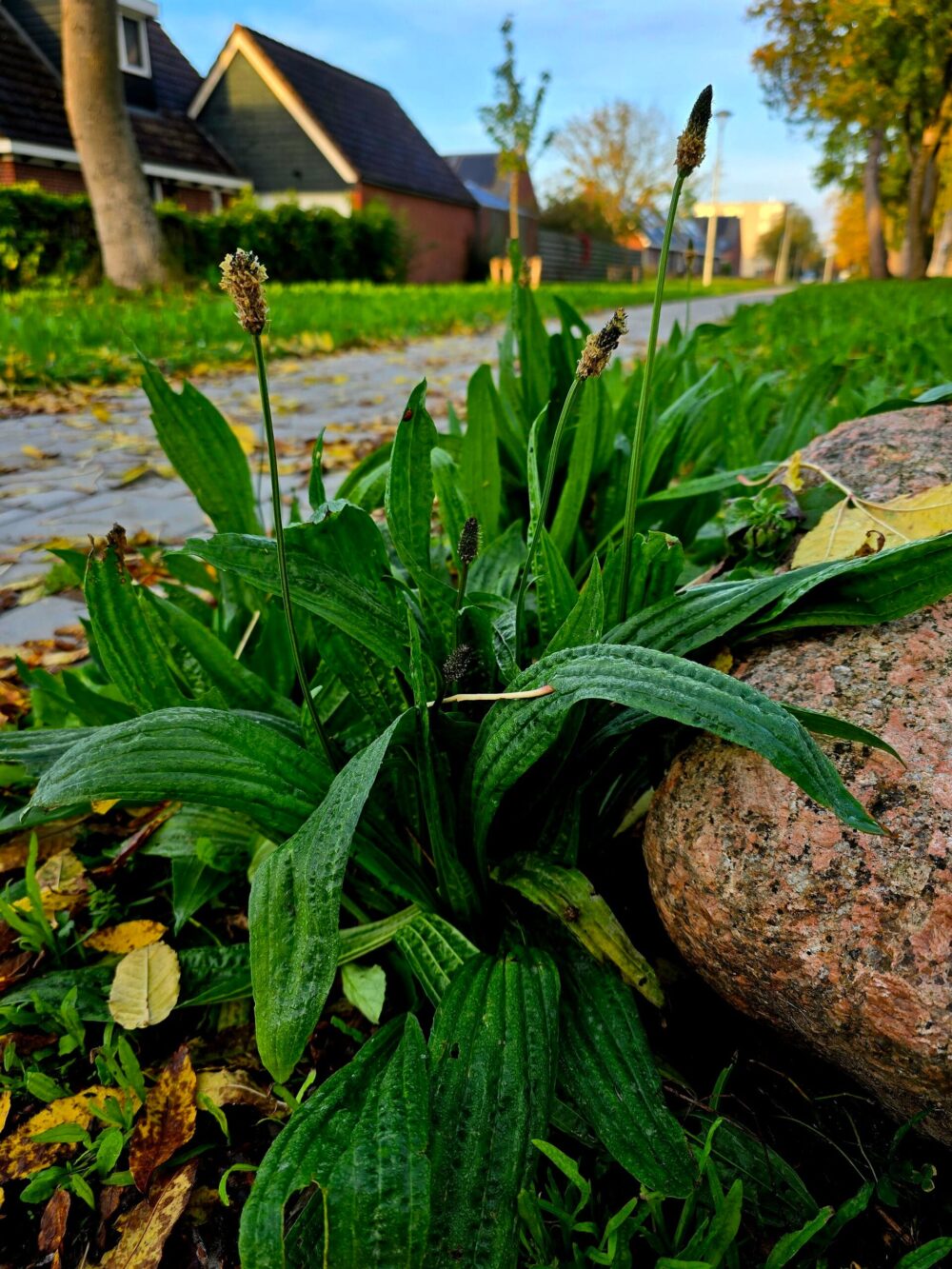
A common perennial rosette plant with narrow, strongly ribbed leaves and small brown flowerheads carried on deeply grooved stalks.
Ribwort plantain is widespread in grasslands, lawns, field margins and disturbed places. Its young leaves and seeds are edible, while the leaves also have a long history of traditional European herbal use.
Correct identification remains important. Check the complete plant, including its basal rosette, prominent leaf veins, grooved flower stalks and characteristic flowerheads.
Young leaves: spring to early summer, with fresh regrowth appearing throughout the year
Flower buds: late spring to summer
Mature seeds: summer to autumn
Lawns, meadows, pastures, field margins, paths, roadsides, gardens, parks, railway banks and disturbed ground
The leaf rosette usually remains below 30 centimetres, while flowering stalks commonly reach approximately 10–50 centimetres
Young healthy leaves, unopened flowerheads and mature seeds — only after certain identification
Ribwort plantain belongs to the plantain family, Plantaginaceae. It is a perennial plant that survives through winter as a low rosette or underground rootstock and produces new leaves and flower stalks during the growing season.
It is native across much of Europe, temperate Eurasia, North Africa and Macaronesia, but has also become established in many other parts of the world.
Ribwort plantain tolerates mowing, grazing, dry weather and moderately compacted soil. Its leaves remain close to the ground, allowing the plant to survive in places where taller vegetation is repeatedly cut or walked over.
The plant is valuable to wildlife. Its flowers provide pollen, its seeds are eaten by birds and small animals, and its leaves are used by several insects.
For people, ribwort plantain has a long history as both a wild food and a traditional household herb. The youngest leaves can be added to cooked dishes, while mature leaves are usually too fibrous for pleasant eating. The dried leaf is also recognised within European traditional herbal practice.
Ribwort plantain grows as a basal rosette, meaning that all the leaves arise close to the ground from a central growing point.
The leaves are narrow, lance-shaped and usually much longer than they are wide. They commonly measure approximately 10–30 centimetres long, although their size varies according to soil, moisture, season and mowing.
Each leaf gradually narrows towards both the pointed tip and the base. The margins are normally smooth or only slightly toothed.
The most characteristic feature is the set of three to five strong, almost parallel veins running from the base towards the tip. These veins are especially prominent on the underside of the leaf.
When a leaf is carefully pulled apart, the strong veins may stretch into pale elastic strands. This can support identification, but it should not be used as the only identifying feature.
The leaves may be smooth or lightly hairy. Plants growing in exposed or frequently mown places often form compact, flat rosettes, while those growing among taller grass may produce longer and more upright leaves.
Ribwort plantain sends up leafless flowering stalks from the centre of the rosette. Each stalk is firm and marked by several deep longitudinal grooves or ridges.
The flowering stalks do not carry leaves or branches.
A short, compact flowerhead develops at the top of each stalk. It is usually oval or cylindrical and becomes brown as the flowers mature.
The individual flowers are small and inconspicuous. During flowering, pale cream or white stamens extend from the flowerhead and often form a delicate ring that gradually moves upwards as flowering progresses.
After pollination, the flowerhead produces many small seed capsules. Each capsule normally contains a small number of smooth brown seeds.
The roots form a short central rootstock with numerous fibrous roots. Ribwort plantain should not be identified by its roots alone.
Use several characteristics together: a basal rosette, narrow lance-shaped leaves, three to five strong parallel veins, leafless deeply grooved stalks and compact brown flowerheads with pale protruding stamens.
Never identify ribwort plantain from one detached leaf or from a photograph alone. Check the entire growing plant and observe the flower stalks whenever possible.
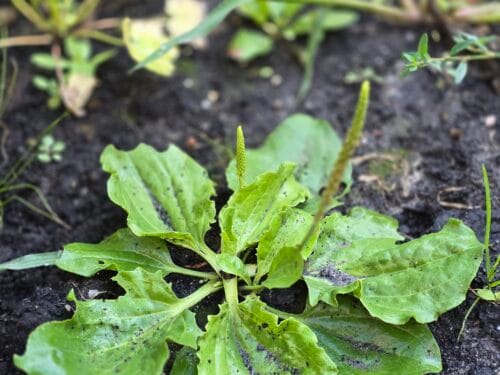
Greater plantain is a closely related and very common species.
It forms a basal rosette but has much broader, oval or spoon-shaped leaves. The leaf blade usually narrows abruptly into a noticeable stalk rather than gradually tapering like ribwort plantain.
Its flowering spikes are generally longer and narrower, while the supporting stalks are usually less deeply grooved.
Correctly identified greater plantain is also edible and has its own history of traditional use. However, the two species should be described and harvested separately when a preparation specifically calls for Plantago lanceolata.
Hoary plantain also forms a rosette and may have relatively narrow leaves.
Its leaves are normally broader than those of ribwort plantain and are often covered with short greyish hairs. They usually have a short, broad leaf stalk.
The flowers may appear more decorative, with pale pink or purple-tinged filaments extending from the flowerhead.
Correctly identified hoary plantain is not generally considered a dangerous confusion species, but it should not automatically be substituted in preparations intended specifically for ribwort plantain.
Buck’s-horn plantain commonly grows in coastal areas, sandy ground, compacted paths and other disturbed places.
Its leaves are narrow but are usually deeply divided into pointed lobes, giving them an antler-like appearance.
Ribwort plantain leaves are normally entire and lance-shaped rather than deeply lobed.
Sea plantain grows mainly in salt marshes, coastal grassland and other saline habitats.
It has narrow, fleshy leaves that may superficially resemble ribwort plantain. However, its leaves are usually thicker and more succulent, and its habitat is an important clue.
Do not harvest plants from salt marshes or protected coastal habitats without checking local access and conservation rules.
Young foxglove can also form a basal rosette and must not be confused with an edible plant.
Foxglove leaves are normally broader, softer and more heavily textured. They have a network of branching veins rather than the strong, nearly parallel ribs of ribwort plantain.
Foxglove leaves and flowers are poisonous and contain cardiac glycosides that can seriously affect the heart.
Never consume a plant simply because it forms a rosette. If the leaves are broad, soft, strongly hairy or lack the characteristic parallel ribs, leave the plant alone.
Many grasses and unrelated wild plants produce narrow leaves close to the ground.
Grasses normally have leaves attached along jointed stems and do not form the same combination of a broadleaf rosette, elastic veins and compact plantain flowerheads.
Always inspect the complete plant rather than relying on leaf shape alone.
The young leaves, unopened flowerheads and mature seeds of correctly identified ribwort plantain are edible.
The youngest spring leaves are the most tender. They have a mild earthy flavour that is sometimes compared with mushrooms.
Young leaves may be used in:
Mixed cooked greens
Soups and stews
Omelettes and savoury pancakes
Pestos and green sauces
Herb butters
Fritters
Vegetable fillings
Savoury pies
Crispy baked snacks
Small additions to salads
Even young leaves can contain strong fibres. Slice them across the veins or chop them finely before cooking.
Older leaves become increasingly tough and stringy. They are better suited to strained infusions or long-cooked preparations than to salads.
The young unopened flowerheads have a concentrated earthy or mushroom-like flavour. They may be briefly sautéed or added in small quantities to savoury dishes.
The mature seeds are tiny and time-consuming to collect, but they can be dried and added to breads, crackers, porridge or seed mixtures. They are not the same commercial product as psyllium husk, which usually comes from other Plantago species.
Ribwort plantain should be treated as one ingredient within a varied diet rather than as a major source of calories or nutrients.
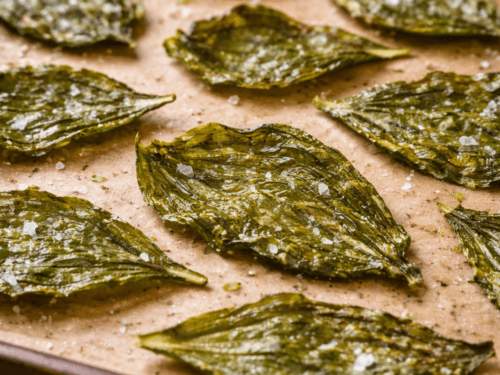
Only harvest ribwort plantain after confirming the complete plant. Do not identify it from one narrow leaf alone.
Pay particular attention to poisonous rosette-forming plants such as foxglove. Foxglove does not have the same combination of narrow lance-shaped leaves, strong parallel ribs, deeply grooved leafless stalks and small plantain flowerheads.
Harvest only clean, healthy leaves. Avoid leaves that are yellowing, mouldy, heavily spotted, unusually discoloured or damaged by animals.
Ribwort plantain frequently grows on paths, lawns and other places exposed to contamination. Do not collect plants from beside busy roads, industrial land, recently sprayed fields, chemically treated lawns, polluted water or frequently used dog-walking routes.
Wash edible leaves carefully in clean water before use.
The strong veins can make older leaves difficult to chew and swallow. Chop them finely and cook them well, particularly when serving them to children or people with swallowing difficulties.
Some people may be allergic to plantain plants or their pollen. Stop using the plant and seek medical assistance if swelling, breathing difficulties or another serious reaction occurs.
Fresh wild leaves should not be placed directly onto deep, dirty, infected or heavily bleeding wounds. Plant material can introduce dirt and microorganisms. Serious wounds, animal bites, burns and signs of infection require appropriate medical care.
Traditional plantain preparations should not replace medical treatment for persistent coughs, breathing difficulties, fever, infected wounds or severe allergic reactions.
The safety of concentrated medicinal preparations during pregnancy, breastfeeding and for young children has not been adequately established. Seek advice from an appropriately qualified healthcare professional before medicinal use.
If a cough is accompanied by shortness of breath, high fever, chest pain, blood, worsening symptoms or unusual sputum, seek medical advice.
Harvest only where collecting is permitted and obtain the landowner’s permission where required.
Choose large, healthy and abundant patches growing in clean locations.
Take a small number of young outer leaves from several different rosettes rather than removing every leaf from one plant.
Leave the central growing point intact so the plant can continue producing new leaves.
Do not pull up the complete plant when only the leaves are needed.
Leave plenty of flowerheads to produce seed and provide food for wildlife.
Avoid collecting every young flowerhead from a patch. Mature seed production helps maintain the local population.
Use scissors or pinch individual leaves carefully rather than uprooting the plant.
Do not harvest rare or unusual plantain species when you are uncertain of their identity.
Avoid trampling surrounding vegetation while collecting low-growing leaves.
Ribwort plantain often grows abundantly, but its commonness does not justify careless harvesting or habitat damage.
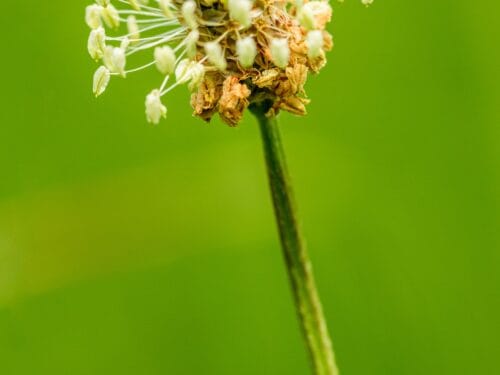
Ribwort plantain has traditionally been valued as a wild food and as part of European household herbal practice.
The leaves were traditionally used in:
Ribwort plantain leaves were traditionally associated with soothing irritated mouths and throats and with relieving dry, irritating coughs.
The European Medicines Agency recognises ribwort plantain leaf as a traditional herbal medicinal product for irritation of the mouth or throat with an associated dry cough, and for the relief of cough associated with the common cold.
This recognition is based on longstanding traditional use. It does not mean that ribwort plantain can cure respiratory infections or replace medical assessment when symptoms are severe or persistent.
Fresh leaves were also historically crushed and placed onto minor insect bites, grazes and irritated skin. This traditional practice does not prove that unsterilised leaves can prevent infection or safely treat significant wounds.
Historical herbal traditions also associated plantain leaves with the digestive and urinary systems. These uses have not all received the same level of formal evaluation.
These traditions reflect knowledge and practices passed down through generations. They remain important for understanding how the plant was valued, but traditional use does not make every preparation suitable for every person.
Strong, concentrated or frequently repeated medicinal preparations are not recommended without guidance from an appropriately qualified herbal or healthcare professional.
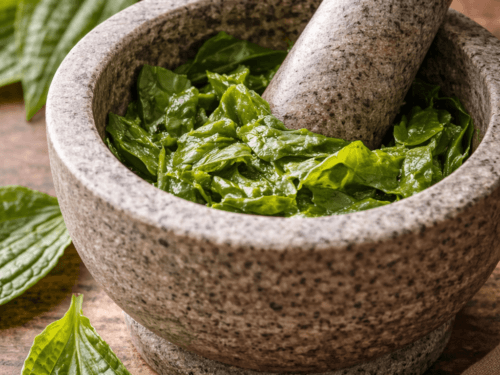
Ribwort plantain leaves contain mucilage-forming polysaccharides. These compounds absorb water and contribute to the smooth, soothing texture associated with plantain infusions.
The leaves also contain iridoid glycosides, including aucubin and catalpol. Their concentrations can vary according to the growing conditions, harvest time, drying process and storage.
Other naturally occurring compounds include phenylethanoid glycosides such as acteoside, as well as flavonoids, phenolic acids and tannins.
Tannins contribute to the mildly dry or astringent sensation of stronger leaf preparations.
The leaves provide dietary fibre and contain varying amounts of minerals and other micronutrients. Their nutritional composition depends on the age of the leaf, soil conditions, season and preparation method.
The seeds contain mucilage and fibre, although ribwort plantain does not produce the large quantities of husk obtained from commercial psyllium species.
Drying and prolonged storage may change the concentration or stability of some plant compounds. Dried leaves should be stored in a clean, dry and dark place and discarded if they develop mould, moisture or an unusual smell.
The presence of mucilage, aucubin, antioxidants or other plant compounds does not by itself demonstrate that ribwort plantain can prevent, treat or cure disease.
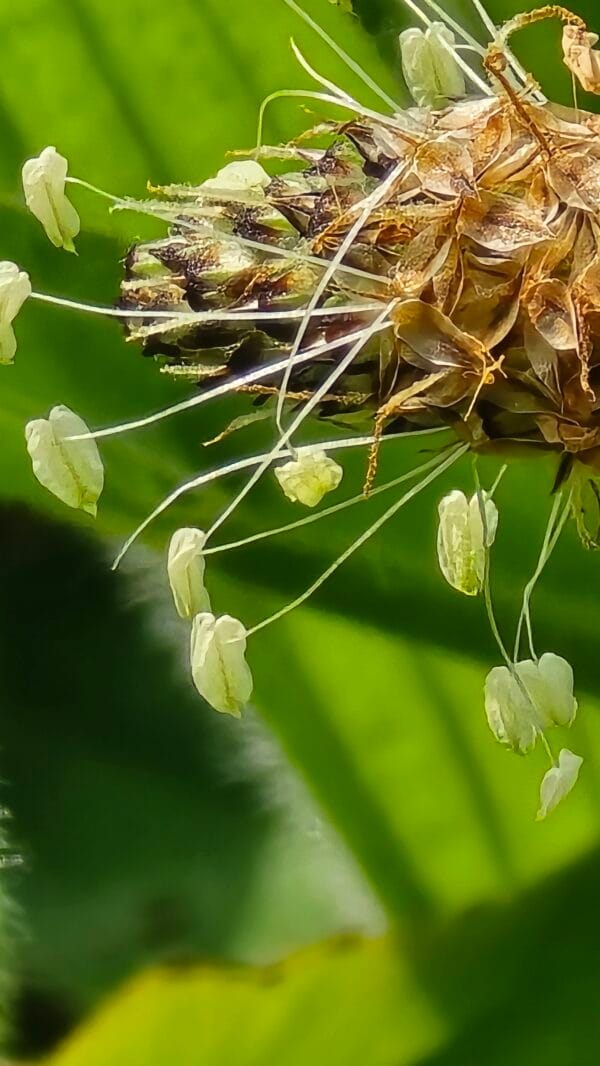
Three to five prominent veins run almost parallel from the base to the tip
Pale stamens form a visible ring that gradually travels upwards around the flowerhead
The low-growing leaves tolerate mowing, grazing, dry weather and moderate trampling
Young leaves are edible, while the dried leaf has a recognised place in European traditional herbal practice
Learn how to recognise and explore wild plants, fruits and trees safely.
The name “ribwort” refers to the strong ribs running along each leaf.
These ribs contain tough fibres. When a leaf is pulled apart carefully, the fibres may stretch between the broken sections like pale threads.
The flowerhead also changes appearance during flowering. The tiny flowers do not all open simultaneously. Instead, a ring of pale stamens gradually moves from the lower part of the flowerhead towards the top.
This gives the otherwise inconspicuous brown flower spike its characteristic pale halo.