A deciduous shrub or small tree with opposite divided leaves, broad clusters of creamy-white flowers and hanging bunches of small purple-black fruits.
European elder is a familiar plant of hedgerows, woodland edges, gardens and disturbed ground. Its fragrant flowers and fully ripe fruits have a long history of culinary and traditional herbal use.
Correct identification and careful preparation are essential. The flowers may be used after the green stalks have been removed. The ripe fruits should be separated from their stems and thoroughly cooked before consumption.
Flowers: May to July, depending on location and weather
Fully ripe fruits: August to October
Hedgerows, woodland edges, scrub, field margins, gardens, parks, railway banks, roadsides and disturbed ground, particularly in nitrogen-rich soil
Commonly 2–6 metres tall, although mature specimens can sometimes grow considerably larger
Fresh flowers with most green stalks removed and fully ripe purple-black fruits after removal from their stems and thorough cooking
Elder belongs to the family Adoxaceae. It usually grows as a large, branching shrub or small tree and is widespread across much of Europe.
The plant is particularly noticeable in early summer, when it produces broad clusters of small, fragrant, creamy-white flowers. Later in the year, these develop into heavy bunches of small purple-black fruits.
Elder is valuable to wildlife throughout the growing season. Its flowers provide nectar and pollen for insects, while the fruits are eaten by birds and small mammals. The hollow or soft-pithed stems can also provide shelter for insects.
For people, elder is both a seasonal food plant and an important part of European herbal and rural traditions. The flowers are used to flavour drinks, syrups, desserts and preserves. The cooked fruits are used in syrups, sauces, jellies and other preparations.
However, elder must not be treated like an ordinary berry bush. The leaves, bark, roots, green stems, unripe fruits and raw fruit preparations are not suitable for casual consumption.
European elder usually grows as a broad, branching shrub or small tree with several stems emerging close to the base.
The bark of younger branches is greyish-green and often marked with small raised dots called lenticels. Older trunks and branches develop rough, deeply ridged grey-brown bark.
Young elder stems contain a soft white pith. Older branches may become partly hollow. A hollow or pithy stem alone is not sufficient for identification because other plants may share this feature.
The leaves grow in opposite pairs along the stems. Each leaf is pinnate and is normally divided into five or seven leaflets, although the number can vary.
The individual leaflets are oval to lance-shaped with pointed tips and finely serrated edges. They are usually dark green above and paler underneath.
The leaves can produce a distinctive, slightly unpleasant or musty smell when crushed. Do not taste an unknown leaf as an identification test.
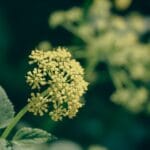
The flowers normally appear from late spring into early summer. They grow in broad, flat or gently domed clusters that may measure 10–25 centimetres across.
Each individual flower is small and creamy-white, with five petals and five pale yellow anthers. The flower clusters have a sweet, floral fragrance.
After successful pollination, the flowers develop into clusters of small green fruits. These gradually change from green to reddish-purple before becoming deep purple-black when fully ripe.
The ripe fruit clusters usually hang or droop under their own weight. Each fruit is approximately 5–7 millimetres across and contains several small seeds.
The juice of ripe elderberries is dark red-purple and can strongly stain hands, clothing and kitchen equipment.
Use several characteristics together: a woody shrub or small tree, opposite pinnate leaves, five to seven serrated leaflets, broad creamy-white flower clusters and hanging bunches of small purple-black fruits.
Never identify elder from flowers, berries or photographs alone. Check the complete plant and observe it through more than one stage of growth whenever possible.
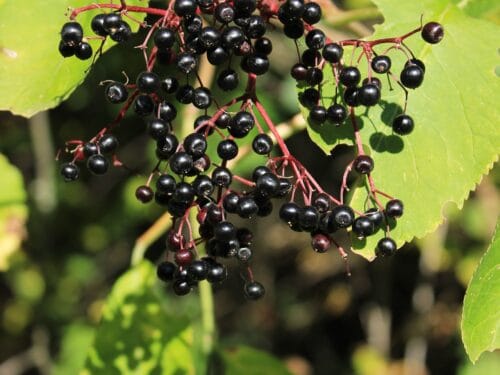
Dwarf elder is one of the most important plants to distinguish from European elder.
Unlike European elder, it is a herbaceous perennial rather than a woody shrub or tree. Its above-ground stems die back during winter and grow again from the ground in spring.
Dwarf elder usually grows in dense colonies of upright, unbranched stems. It commonly reaches approximately 1–2 metres in height.
Its flower clusters are generally more upright than those of European elder. The small white flowers may have noticeably red or purple anthers.
The dark fruits often remain in upright or slightly raised clusters rather than forming the heavy, drooping bunches typical of ripe European elder.
Dwarf elder is poisonous and must not be eaten. Do not harvest from plants unless you can confidently distinguish a mature woody elder shrub from an herbaceous colony.
Red elder is a related species found in parts of Europe and is also grown ornamentally.
Its flowers usually grow in more conical or rounded clusters rather than the broad, flat flowerheads associated with European elder.
The fruits become bright red rather than purple-black.
Do not use red elder as a substitute for European elder. Its identity, chemistry and traditional preparation requirements differ.
Rowan also has pinnate leaves and clusters of small fruits, which can cause confusion when plants are viewed from a distance.
Rowan leaves grow alternately along the twigs rather than in opposite pairs. They normally have a greater number of narrow leaflets.
Its fruits ripen to orange or red rather than purple-black, and it grows as a more clearly defined tree.
A number of unrelated plants produce dark purple or black fruits. Some are inedible or poisonous.
Deadly nightshade produces individual shiny black berries rather than heavy clusters of many small fruits. It is a herbaceous plant with undivided leaves and purple-brown, bell-shaped flowers.
Pokeweed may produce hanging clusters of dark berries but has thick reddish herbaceous stems and simple, undivided leaves. It is not an elder and must not be eaten.
Never identify a dark berry by colour alone. Confirm the growth form, bark, leaf arrangement, leaflet structure, flowers and complete fruit cluster before harvesting.
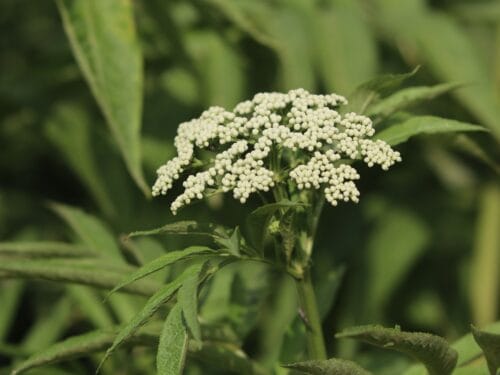
The flowers and thoroughly cooked, fully ripe fruits of correctly identified European elder have established culinary uses.
Elderflowers have a sweet, floral aroma and can be used in:
Cordials and syrups
Lemonades and sparkling drinks
Herbal infusions
Jellies and preserves
Cakes and desserts
Vinegars
Fermented drinks
Lightly battered flower fritters
Flavoured sugars
Seasonal sauces and dressings
Use fresh, clean flower clusters and remove as much of the coarse green stalk material as practical before preparing them.
Do not strip every flower from a plant. Each harvested flower cluster removes a potential cluster of fruit and an important food source for insects.
Only use elderberries when they are completely ripe, soft and uniformly purple-black. Discard green, pale, red or otherwise unripe fruits.
Remove the berries from their stalks and cook them thoroughly before consumption.
Cooked elderberries may be used in:
Syrups
Jellies and jams
Compotes
Sauces
Chutneys
Fruit fillings
Cooked juices
Fermented preparations
Desserts
Vinegars and shrubs
Elderberries have a rich, tart flavour and are normally combined with sweeter fruits, sugar or honey.
Do not use elder leaves, bark, roots, buds or green stems as ordinary food ingredients.
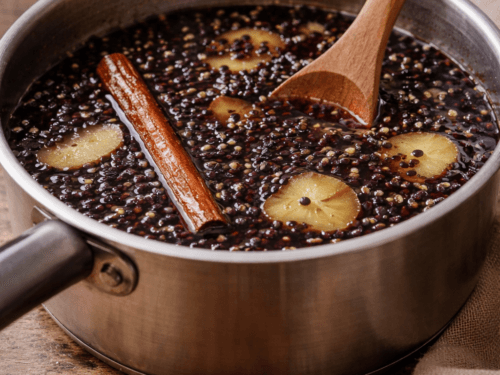
Correct identification and preparation are essential.
Do not consume elder leaves, bark, roots, buds, green stems or unripe fruits. These plant parts contain potentially harmful compounds and may cause nausea, vomiting, abdominal pain, diarrhoea, weakness or other symptoms.
Even fully ripe elderberries can cause stomach and intestinal complaints when eaten raw or insufficiently cooked.
Remove all visible stems and unripe fruits before processing the berries. Cook the ripe fruits thoroughly rather than simply warming them briefly.
Do not use a slow cold infusion, raw juice, smoothie or uncooked syrup as a substitute for proper cooking.
Cooking reduces the risk associated with the fruit, but it does not make leaves, bark, roots or large quantities of stem material suitable for consumption.
Elderflower preparations should contain as little green stalk material as reasonably possible. Do not include leaves or woody branches.
Never make juice by crushing complete elderberry clusters with their stems and leaves still attached.
Discard fruits that are mouldy, fermented-smelling, unusually discoloured, leaking or heavily damaged.
Do not harvest beside busy roads, from industrial or contaminated land, near polluted water, from recently sprayed areas or directly beside frequently used dog-walking routes.
People can occasionally experience an allergic reaction to elderflowers or elderberries. Stop using the preparation and seek medical assistance if swelling, breathing difficulties or another serious reaction occurs.
The safety of concentrated elder preparations during pregnancy, breastfeeding and for young children has not been adequately established. Seek advice from an appropriately qualified healthcare professional before medicinal use.
Elderflower or elderberry products should not replace medical care. Seek professional advice when symptoms are severe, worsening, unusual or persistent.
If someone becomes unwell after consuming raw elderberries, unripe fruits or other parts of the plant, contact a medical professional or poison information service and provide the plant name, consumed part, approximate quantity and preparation method.
Harvest only where collecting is permitted and obtain the landowner’s permission where required.
Choose large, healthy and abundant elder shrubs growing in clean locations.
Take a small number of flower clusters from several different branches rather than removing every flower from one plant.
Leave plenty of flowers for pollinating insects and to develop into fruit later in the season.
When harvesting berries, cut or pick individual ripe clusters carefully without breaking complete branches.
Leave some ripe fruit clusters for birds, mammals and other foragers.
Avoid harvesting flowers or fruits from branches containing active bird nests.
Do not strip bark, cut main stems or dig up roots. These actions can seriously damage or kill the plant and are unnecessary for culinary use.
Avoid trampling surrounding vegetation or forcing paths through wildlife habitat.
Inspect flower clusters for insects before placing them in a bag or basket. Give small insects an opportunity to leave before processing the flowers.
Use an open basket or breathable container while harvesting. Flowers can quickly wilt or ferment when compressed into a warm plastic bag.
Process elderflowers soon after harvesting. Remove damaged flowers, insects, leaves and coarse green stalks.
Harvest elderberries only when the complete cluster is predominantly purple-black. Remove any remaining green or unripe fruits during preparation.
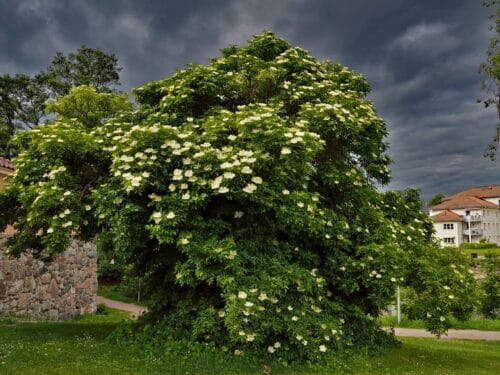
Elder has been valued for centuries as a seasonal food plant, household ingredient and traditional European herb.
The flowers and cooked fruits were traditionally used in:
Elderflowers were traditionally brewed as a warm infusion and associated with sweating during the early stages of colds and feverish illnesses.
European herbal tradition also associated elderflower preparations with the nose, throat and upper respiratory system. This traditional use remains part of modern European herbal practice.
Cooked elderberries were preserved as syrups, juices, jellies and wines for use during autumn and winter. They were traditionally associated with seasonal resilience and recovery during cold weather.
These traditions reflect knowledge and practices passed down through generations. Although not every historical application has been confirmed by modern clinical research, this heritage remains important for understanding how elder was valued and used.
Traditional use does not mean that raw berries, unripe fruit or other green parts of the plant are safe. Historical culinary preparations commonly involved separating the berries from the stalks and heating them.
Elder also has a prominent place in European folklore. The shrub was associated with protection, boundaries, household spirits, transformation and respect for the natural world.
In some traditions, permission was symbolically requested before cutting elder branches. Damaging an elder unnecessarily was believed to bring misfortune, while planting elder near a home was associated with protection.
Concentrated preparations and repeated medicinal use are not recommended without guidance from an appropriately qualified herbal or healthcare professional.
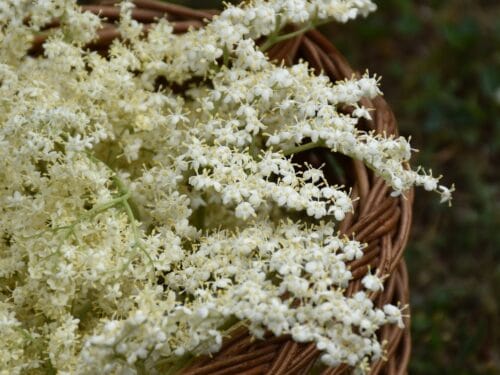
Ripe elderberries contain dark pigments called anthocyanins. These compounds create the fruit’s deep red-purple or black colour.
The berries also contain other polyphenols, including flavonoids and phenolic acids. The precise amounts vary according to the cultivar, growing conditions, stage of ripeness, storage and processing method.
Ripe elderberries provide dietary fibre and contain vitamin C and other micronutrients. Their levels can vary and may change during heating, storage and preservation.
Elderflowers contain flavonoids, phenolic acids and small amounts of aromatic compounds responsible for their distinctive fragrance.
Elder leaves, bark, roots, green stems and unripe fruits contain potentially harmful natural defence compounds, including cyanogenic glycosides. These compounds help protect the living plant from damage and herbivores.
The concentration and composition of these substances vary between plant parts and stages of ripeness. This is why the culinary flowers and properly prepared ripe fruits must be clearly separated from unsuitable parts of the plant.
Removing the stems, discarding unripe berries and thoroughly cooking ripe fruit are essential preparation steps.
The presence of anthocyanins, antioxidants or other plant compounds does not by itself demonstrate that elderberry preparations can prevent, treat or cure disease.
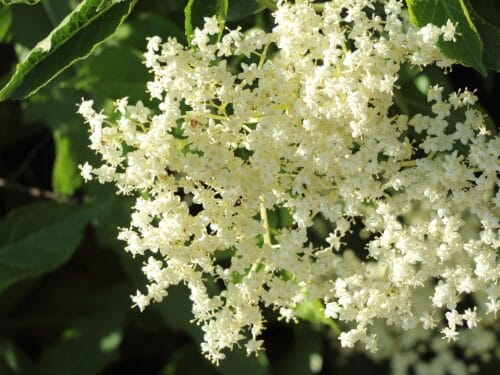
Broad creamy-white flowerheads fill hedgerows with their distinctive early-summer fragrance
Green fruits gradually ripen through red-purple to deep purple-black
Flowers support insects while ripe fruits provide seasonal food for birds and mammals
The flowers are gathered in early summer and the fully ripe fruits later in the year
Learn how to recognise and explore wild plants, fruits and trees safely.
Elder offers two completely different seasonal harvests.
In early summer, the shrub produces broad clusters of fragrant creamy-white flowers. Only a few months later, those same pollinated flower clusters have developed into hanging bunches of dark purple-black fruits.
Each flower can potentially become one elderberry. Harvesting every flower cluster therefore means there will be no fruit left on that part of the plant later in the year.
Leaving plenty of flowers and berries behind supports insects, birds and other wildlife while allowing people to enjoy both elderflower and elderberry season.