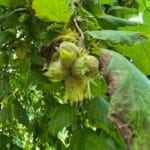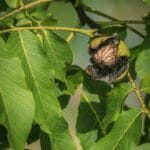
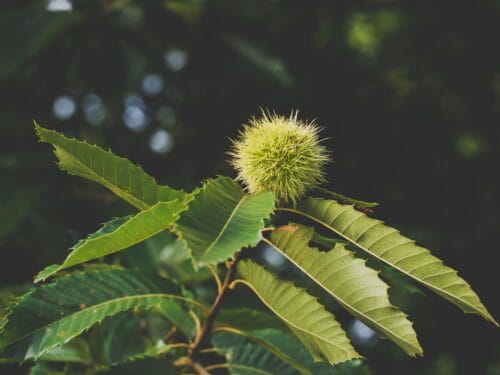
A large, long-lived deciduous tree with deeply ridged bark, long serrated leaves and edible nuts enclosed in extremely spiny green burrs.
Sweet chestnut has been cultivated across Europe for centuries for its nutritious nuts and durable wood. The ripe nuts can be roasted, boiled, ground into flour or used in sweet and savoury dishes.
Flowers: June to July
Ripe nuts: September to November, usually most abundant in October
Woodlands, coppiced woods, parks, old estates, gardens, roadsides and sheltered field margins
Usually 20–35 metres when mature
Fully developed ripe nuts — only after certain identification and removal of the burr, shell and inner skin
Sweet chestnut belongs to the beech family and is native to parts of southern Europe and western Asia. It has been planted much more widely for food, timber and coppice production.
The tree grows best in warm, sunny places with well-drained soil. Ancient specimens can develop enormous trunks with deeply spiralling bark and broad, spreading crowns.
Sweet chestnut flowers provide pollen for insects, while the nuts are eaten by birds, squirrels, mice and other mammals. Old trees also create valuable habitats for fungi, insects and cavity-nesting animals.
The edible nuts differ from most familiar nuts because they contain considerably more starch and less fat. This gives cooked chestnuts their soft, slightly sweet and floury texture.
Sweet chestnut is a large deciduous tree that develops a broad crown when allowed to grow freely.
Young bark is smooth and grey-brown. As the tree matures, the bark becomes dark, deeply ridged and often appears to twist or spiral around the trunk.
The leaves are arranged alternately along the twigs. Each leaf is simple, long and narrow rather than divided into separate leaflets.
Mature leaves commonly measure around 15–25 centimetres long. They are glossy green with many straight side veins. Each vein ends in a sharp triangular tooth along the leaf margin.
The yellowish male flowers grow in long, upright or spreading catkins during early summer. Female flowers occur near the base of some catkins and later develop into the spiny fruits.
The developing nuts are enclosed in round green burrs covered with numerous long, thin and densely packed spines.
As the burr ripens, it turns yellow-brown and splits into several sections. Each burr normally contains one to three shiny brown nuts.
The individual nuts are rounded or flattened depending on their position inside the burr. Each nut has a pointed tip with a small pale tuft and a lighter attachment scar at its base.
Inside the shiny outer shell is a cream-coloured kernel covered by a thin brown inner skin known as the pellicle.
Use several characteristics together: alternate long serrated leaves, straight parallel side veins, long summer catkins and densely spined burrs containing pointed brown nuts.
Never identify an unknown nut by its brown colour alone.
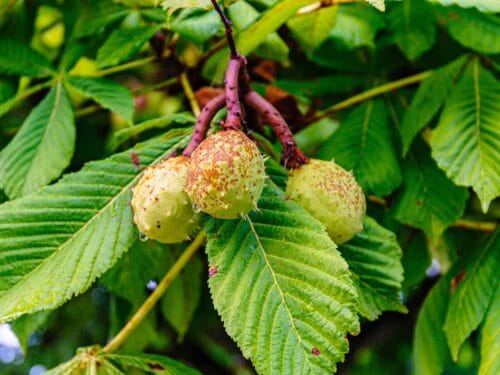
Horse chestnut is not closely related to sweet chestnut. Its conkers are not edible and must never be used as a substitute for sweet chestnuts.
Sweet chestnut has long, single leaves with sharply serrated edges. Horse chestnut has large hand-shaped leaves divided into five to seven separate leaflets.
Sweet chestnut leaves grow alternately along the twigs. Horse chestnut leaves are arranged in opposite pairs.
The burr of sweet chestnut is covered with many long, thin and densely packed spines. Horse chestnut fruits have a thicker green capsule with fewer, shorter and more widely spaced spikes. Some horse chestnut capsules are almost smooth.
Sweet chestnut burrs normally contain one to three nuts. These nuts often have flattened sides, a pointed tip and a small pale tuft.
Horse chestnut generally produces a rounder conker with a large pale attachment scar and no pointed tuft. The conker is usually surrounded by plenty of empty space inside its capsule.
Do not rely on the nut alone. Check the leaves, their arrangement, the fruit case and the complete tree.
If you cannot clearly confirm sweet chestnut, do not collect or eat the nuts.
Other members of the genus Castanea may be planted in parks, gardens and orchards. Their nuts may also be edible, but the leaves, burrs and nut shape can differ.
Hybrids and cultivated varieties also occur. Confirm the tree separately rather than assuming that every spiny-burred tree is Castanea sativa.
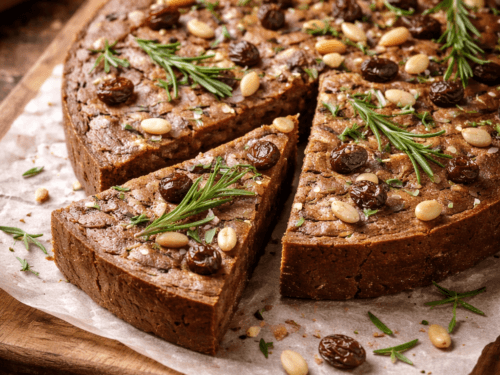
The ripe kernels of correctly identified sweet chestnuts are edible after the burr, hard shell and inner skin have been removed.
Fresh chestnuts have a firm, slightly sweet and starchy texture. Cooking softens the kernel and develops a richer, warmer flavour.
Sweet chestnuts can be used in:
Roasted chestnuts
Boiled or steamed chestnuts
Soups and stews
Stuffings and savoury bakes
Mashed chestnuts
Chestnut flour
Breads, cakes and biscuits
Desserts and sweetened purées
Pasta and gnocchi
Vegetarian patties and fillings
Score the shell with a shallow cut before roasting or boiling. This allows steam to escape and helps prevent the chestnuts from bursting during cooking.
Avoid cutting deeply into the kernel. Peel away both the hard outer shell and the thin brown inner skin, preferably while the cooked chestnuts are still warm.
Small, flat or lightweight nuts are often undeveloped and may contain little usable food.
Horse chestnuts are not edible. Always confirm the long serrated leaves and densely spined burr before gathering sweet chestnuts.
The burrs have extremely sharp spines that can puncture skin. Wear sturdy gloves and footwear and never squeeze a closed burr with bare hands.
Score chestnut shells before heating them. Unscored nuts can burst as steam builds inside.
Eat only fresh, healthy chestnuts. Discard nuts that are mouldy, shrivelled, unusually discoloured, fermented-smelling or damaged by insects.
Chestnuts can cause allergic reactions. People with latex allergy may also react to chestnut because of cross-reactive proteins. Anyone with a known chestnut allergy must avoid them.
Whole chestnuts can present a choking risk to young children. Serve them in a suitably chopped, mashed or puréed form.
Harvest only where collecting is permitted and obtain the landowner’s permission where required.
Gather freshly fallen ripe nuts rather than breaking branches or removing green burrs from the tree. Take a modest amount and leave plenty for wildlife.
Wear sturdy gloves when handling the sharp burrs. Avoid trampling woodland plants or disturbing animals sheltering around old trees.
Choose nuts from healthy trees growing away from busy roads, contaminated land and recently sprayed areas.
Check each nut carefully and process or refrigerate it soon after harvesting. Fresh chestnuts contain relatively high levels of moisture and can spoil more quickly than dried nuts.
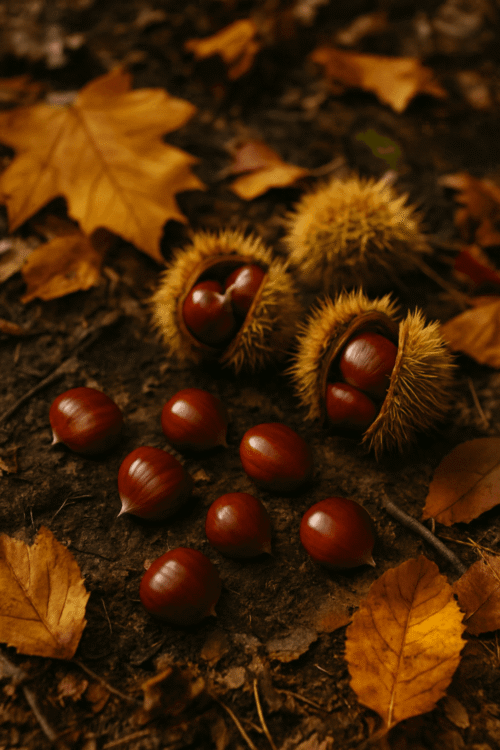
Sweet chestnut has traditionally been valued as an important autumn food and source of durable timber.
The nuts and wood were used in:
In parts of southern Europe, dried chestnuts were ground into flour and used as an important alternative to cereal grains. The nuts provided a storable source of food in mountainous areas where wheat did not always grow well.
Sweet chestnut trees were also managed as coppice. Trees were cut close to ground level so that multiple straight poles could regrow from the stump.
The leaves and bark have appeared in traditional household and herbal preparations. These historical uses are different from eating the cooked nuts and should not be treated as instructions for self-treatment.
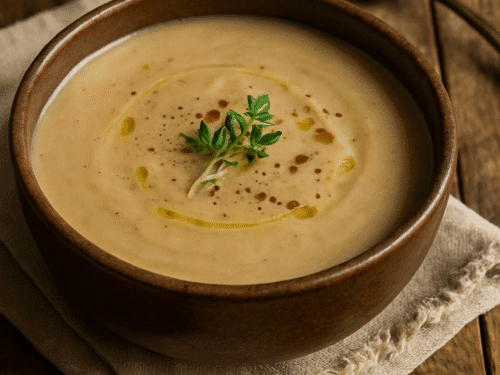
Sweet chestnuts contain mainly carbohydrates, particularly starch, giving them a different nutritional profile from fattier nuts such as walnuts and hazelnuts.
They also provide dietary fibre and contain minerals including potassium, copper and manganese. Small amounts of protein and fat are present.
Fresh chestnuts contain vitamin C, although the amount varies and may decrease during storage and cooking.
The nuts and their inner brown skins also contain phenolic compounds and tannins. The pellicle can taste bitter or astringent and is normally removed before eating.
Nutrient levels vary according to cultivar, growing conditions, storage and preparation. The presence of vitamins, minerals or plant compounds does not by itself demonstrate that chestnuts can prevent or treat disease.
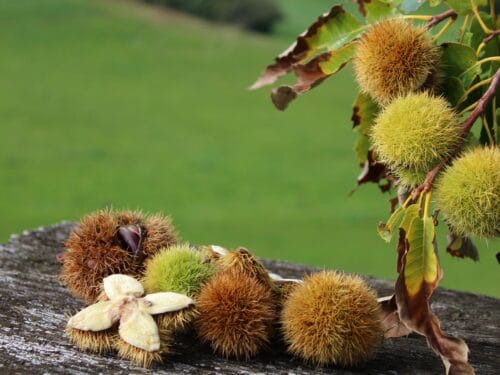
Ripe nuts develop inside round burrs covered with many sharp spines.
Cooked chestnuts have a soft, mildly sweet and floury texture.
Chestnuts have provided autumn and winter food for many generations.
Cut trees can produce multiple straight poles from the original stump.
Learn how to recognise and explore wild plants, fruits and trees safely.
Despite their similar names, sweet chestnut and horse chestnut are not closely related.
Sweet chestnut belongs to the beech family, while horse chestnut belongs to the soapberry family.
A mature sweet chestnut can live for several hundred years. Ancient trees often develop enormous hollow trunks with deeply spiralling bark.
The word sativa means cultivated, reflecting the tree’s long history as a food crop.