A familiar multi-stemmed shrub or small tree with rounded, softly hairy leaves, long yellow catkins and edible nuts held inside leafy green husks.
Common hazel is widespread across much of Europe. Its ripe nuts can be eaten raw or roasted and used in savoury dishes, baking, confectionery, spreads and drinks.
Young leaves: spring
Ripe hazelnuts: September to October
Fallen nuts may remain usable for a short period in dry weather
Woodland edges, hedgerows, scrub, coppice, field margins, parks, gardens and mixed deciduous woodland
Usually 3–8 metres, although old or unmanaged plants may grow taller
Fully ripe hazelnut kernels, removed from their leafy husks and hard shells
Common hazel belongs to the birch family and usually grows as a broad, multi-stemmed shrub. New shoots develop from the base, allowing the plant to form dense clumps.
Hazel has been managed through coppicing for centuries. When the stems are cut close to the ground, the plant produces new straight shoots that can be harvested repeatedly without killing the root system.
The long male catkins release pollen during late winter and early spring, often before the leaves appear. The much smaller female flowers develop into clusters of hazelnuts after successful wind pollination.
Hazelnuts provide an energy-rich autumn food for squirrels, mice, jays and other wildlife. Small mammals may carry and bury the nuts, sometimes allowing forgotten seeds to grow into new plants.
For people, ripe hazelnuts are a versatile wild food. Their flavour becomes deeper and sweeter when roasted, and the kernels can be used whole, chopped, ground or blended.
Common hazel usually grows as a broad, densely branched shrub with several stems rising from its base. Older stems have smooth or slightly peeling grey-brown bark, while younger twigs are brown and may be softly hairy. Hazel does not have thorns.
The leaves are arranged alternately along the twigs. They are broadly rounded or heart-shaped, with a pointed tip and distinctly double-serrated margins. The upper surface is matt green, while the leaves and stalks may feel softly hairy, especially when young.
Long male catkins are often visible during autumn and winter. They lengthen in late winter or early spring and release clouds of yellow pollen before the leaves appear.
The female flowers are much smaller and remain mostly hidden inside rounded buds. Only a small tuft of crimson-red styles can normally be seen.
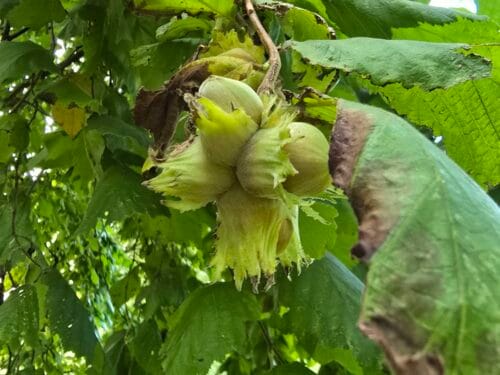
After pollination, the female flowers develop into clusters of nuts surrounded by green, leaf-like husks. The husk of common hazel is normally about the same length as the nut or only slightly longer and does not completely enclose it.
The nuts change from pale green to warm brown as they mature. Ripe nuts loosen from their husks and may fall naturally. Inside the hard shell, a healthy kernel should be firm, filled out and cream-coloured.
Use several characteristics together: multi-stemmed growth, rounded double-serrated leaves, long male catkins, tiny red female flowers and hard-shelled nuts held within short leafy husks.
Never identify an unknown nut from its brown shell or kernel alone.
Filbert is closely related to common hazel and has similar leaves, catkins and edible nuts.
Its fruit is usually enclosed by a longer, tubular and often fringed husk that extends beyond the nut. Common hazel has a shorter and more open leafy husk.
Turkish hazel is often planted in streets and parks. It usually develops into a tall, single-trunked tree rather than a broad, multi-stemmed shrub.
Its edible nuts grow in dense clusters surrounded by deeply divided and bristly husks.
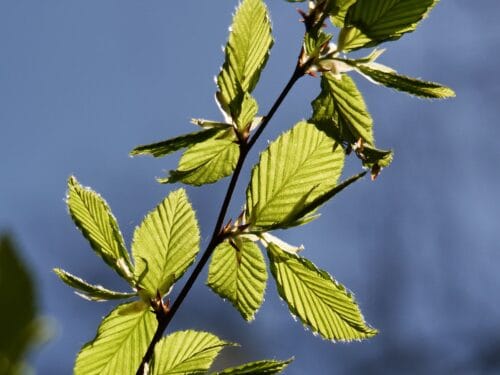
Hornbeam has alternate, serrated leaves with strong parallel veins. Its leaves are usually more elongated and pleated than the rounder, softer leaves of hazel.
Hornbeam produces small nutlets attached to three-lobed papery bracts rather than round nuts held inside leafy husks.
Alder also produces hanging male catkins but normally grows on wetter ground. Its female flowers develop into small woody cone-like structures rather than hazelnuts.
Beech produces triangular nuts inside sharply spined cases. Its leaves are more oval and have smooth or gently wavy margins rather than the strongly double-serrated edges of hazel leaves.
Beechnuts require their own identification and preparation guidance and should not be eaten in large quantities.
Horse chestnut produces large, glossy brown conkers inside thick green cases. Its leaves are divided into several large leaflets spreading from one central point.
Hazel has single rounded leaves arranged alternately along the twigs. Conkers are not edible and may cause significant digestive illness.
Never assume that every brown nut found beneath a tree is edible.
The mature kernels of correctly identified common hazel are edible once the leafy husk and hard shell have been removed.
Fresh kernels have a mild, creamy and slightly sweet flavour. Drying or roasting develops a deeper and more recognisable hazelnut flavour.
Hazelnuts can be used in:
Roasted nut mixtures
Cakes, biscuits and pastries
Homemade nut butter
Chocolate spreads and confectionery
Granola, muesli and porridge
Pestos and savoury sauces
Nut-based drinks
Desserts and ice cream
The thin brown skin around the kernel is edible but may taste slightly bitter. After roasting, part of this skin can be removed by rubbing the warm nuts in a clean cloth.
For the best flavour and storage life, allow the nuts to ripen fully. Do not eat the hard shell, leafy husk or kernels that are mouldy, rancid, unusually bitter, shrivelled or damaged by insects.
Young hazel leaves and catkins appear in traditional practices but are not as well established as everyday foods as the ripe nuts.
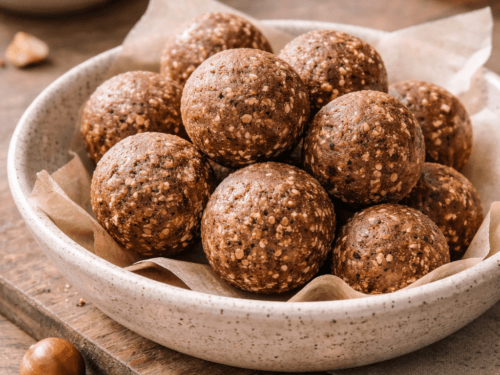
Hazelnuts are tree nuts and can cause serious allergic reactions. Anyone with a known hazelnut or tree-nut allergy must avoid them, including foods that may have been contaminated during processing.
Symptoms may include itching, hives, swelling, vomiting, breathing difficulties, dizziness or collapse. A severe reaction requires immediate emergency medical treatment.
Some people with birch-pollen allergy experience itching or tingling in the mouth after eating raw hazelnuts. This is known as pollen-food syndrome. Symptoms involving nuts should always be taken seriously, and a suspected allergy should never be tested at home.
Only eat nuts from a plant that has been identified with certainty. Check every kernel after cracking and discard nuts that are blackened, soft, mouldy, rancid, unusually bitter, sour-smelling or damaged by insects.
Nuts gathered from damp ground may develop mould. Dry the nuts properly and store them in a cool, dry place. Shelled kernels can be refrigerated or frozen for longer storage.
Whole hazelnuts are a choking hazard for young children. Offer them only in an age-appropriate form, such as finely ground nuts or smooth nut butter, while still considering allergy risk.
Concentrated preparations made from hazel leaves, bark or catkins are different from eating the ripe nuts. Their safety during pregnancy, breastfeeding and for young children has not been adequately established.
Harvest only where collecting is permitted and obtain the landowner’s permission where required.
Choose healthy, productive shrubs growing away from busy roads, polluted ground and recently sprayed areas.
Take a modest quantity from several shrubs rather than removing every nut from one plant. Leave plenty for squirrels, mice, birds and other wildlife.
Collect ripe nuts individually or gather clean, recently fallen nuts during dry weather. Leave nuts that are damp, mouldy, old or heavily damaged.
Do not shake shrubs violently, break fruiting branches or cut stems simply to reach the nuts.
Hazel coppice and old boundary shrubs can have considerable ecological and cultural value. Do not collect wood or cut stems without specific permission.
Take only what you can clean, dry and store properly.
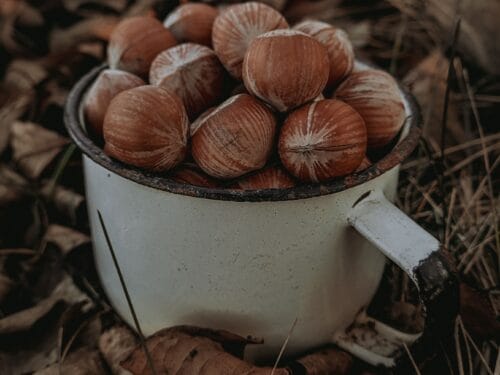
Hazel has traditionally been valued as a source of food, flexible wood and useful materials throughout Europe.
The ripe nuts were traditionally used in:
Hazel leaves, bark and catkins also appear in European herbal traditions. Astringent preparations were historically associated with the skin, mouth, throat, circulation and digestive system.
These practices form part of the plant’s cultural history and reflect knowledge passed down through generations. They should not be interpreted as proof that homemade hazel preparations can prevent, treat or cure medical conditions.
Because the leaves and bark contain tannins, strong or frequently repeated preparations may irritate the digestive system and are not recommended without appropriate professional guidance.
Hazel was traditionally coppiced to produce long, flexible poles. These were used for fencing, baskets, fish traps, garden supports, tool handles, charcoal and wattle-and-daub construction.
The plant also has a prominent place in European folklore. Hazel was associated with wisdom, inspiration, protection and hidden knowledge. Forked twigs were traditionally used as divining rods, while the nuts symbolised fertility and new life.
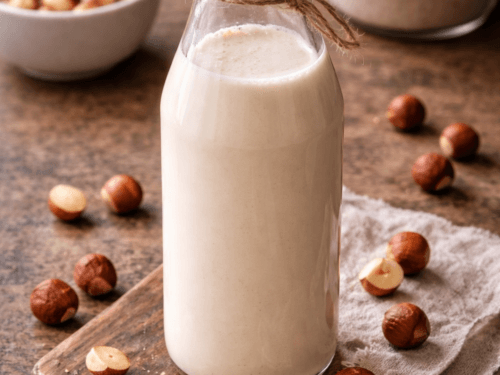
Hazelnuts are naturally rich in oils, most of which are unsaturated fats. Oleic acid is normally the principal fatty acid.
The kernels also provide plant protein, dietary fibre and vitamin E, together with varying amounts of folate, magnesium, copper, manganese and phosphorus.
The thin brown skin contains polyphenols and contributes colour, flavour and slight bitterness.
Hazel leaves and bark contain tannins and other phenolic compounds. Their composition differs from that of the edible kernel.
The exact nutritional composition varies with the individual plant, growing conditions, ripeness, drying, storage and preparation. Roasting changes the flavour and texture but does not remove the risk of a serious hazelnut allergy.
The presence of vitamins, minerals, unsaturated fats or antioxidants does not by itself demonstrate that hazelnuts can prevent or treat disease.
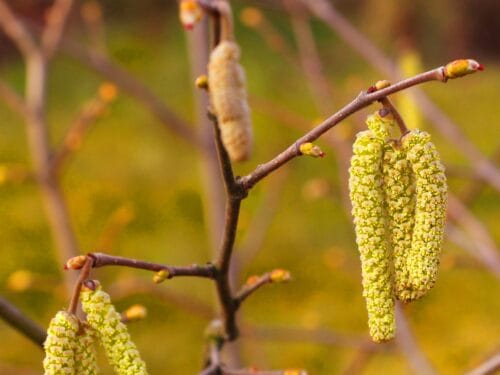
Long yellow catkins release pollen before most woodland leaves have opened.
Ripe hazelnuts provide fats, protein, fibre and a deep flavour when roasted.
Cut stems regrow from the base and have supplied flexible poles for centuries.
Nuts feed mammals and birds while dense growth provides shelter and nesting habitat.
Learn how to recognise and explore wild plants, fruits and trees safely.
Hazel produces male and female flowers on the same plant.
The long yellow catkins are male and release pollen into the wind. The female flowers are so small that only their crimson-red styles can normally be seen emerging from the bud.
Hazel shrubs can live for many years. When regularly coppiced, the root system survives and continually produces new stems.
A hazelnut is a true botanical nut. Its hard shell develops from the ovary wall and normally contains a single edible seed.