
October brings sweet chestnuts, walnuts, acorns and woodland fungi. Discover what to look for, how to prepare each find correctly and how to turn autumn’s harvest into warming dishes and homemade favourites.
This guide focuses on the Netherlands and nearby regions with a similar climate. Harvest times vary with local conditions.
Autumn nuts and woodland fungi, with plenty of possibilities for your kitchen.
Sweet chestnuts, walnuts and acorns, with giant puffballs where conditions suit.
Woodland edges, mature trees and grassy areas where harvesting is permitted.
Gather only what you need and leave plenty of nuts and habitat for wildlife.
Explore these four autumn finds, from fallen nuts to giant puffballs. Open each guide for detailed identification, possible lookalikes and essential preparation advice.
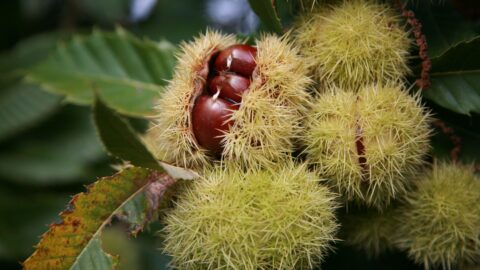
Castanea sativa
Shiny brown nuts with pointed tips grow inside husks covered in densely packed, fine spines.
Long, lance-shaped leaves have sharply toothed edges. Ripe nuts fall from opening husks in autumn.
Safety: Do not confuse sweet chestnuts with poisonous horse chestnuts, which have rounder nuts and sparsely spined husks. Check each kernel and discard mouldy nuts. Score the shells before roasting and remove both shell and inner skin.
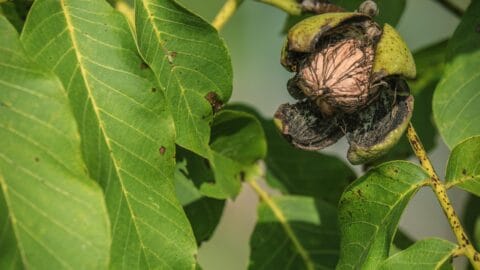
Juglans regia
Rounded green husks surround hard, deeply wrinkled shells containing the familiar folded walnut kernels.
Leaves are divided into several oval leaflets, with a larger leaflet at the tip. Mature nuts fall in autumn.
Safety: Remove the outer husks, crack the shells and inspect each kernel. Discard mouldy or rancid nuts and dry those intended for storage. Avoid walnuts if allergic; whole nuts are a choking hazard for young children.
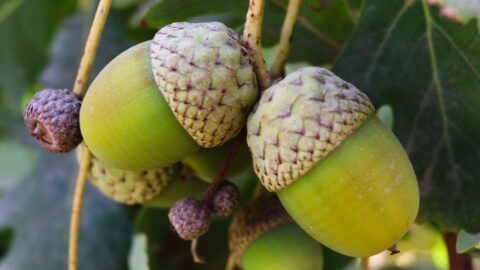
Quercus spp.
Oval nuts sit in rough, scaly cups and turn from green to brown as they mature.
Look for the parent oak and check its leaves as well as the fallen nuts. Gather healthy, undamaged acorns.
Safety: Acorns need thorough leaching to remove bitter tannins before use as food. Shell and sort them, then follow the guide’s preparation method. Roasting alone does not replace leaching. Discard mouldy kernels and nuts with insect damage.
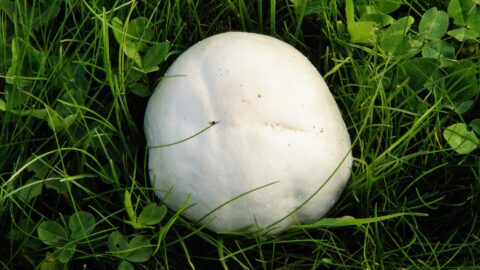
Calvatia gigantea
A large, rounded white fruiting body grows in grassy places, without a distinct cap or gills.
The surface is smooth to slightly uneven. Young specimens have firm, uniformly white flesh throughout.
Safety: Confirm identification and cut every specimen from top to bottom. Reject any with yellowing, dark areas or internal cap, gill or stem structures. Poisonous mushrooms can resemble small puffballs. Get expert help while learning and cook thoroughly.
Bring autumn’s harvest into your kitchen with comforting homemade recipes. From walnut and apple crumble to acorn pancakes and crispy puffball schnitzel, these dishes offer simple ways to explore the season’s flavours.
A few simple precautions will help you enjoy October’s harvest safely and responsibly.
Check several identifying features. Get expert help with mushrooms while learning.
Avoid polluted ground and sprayed areas. Check that harvesting is permitted.
Gather from abundant sources and leave plenty of nuts and fungi for wildlife.
Leach acorns thoroughly, inspect nut kernels and follow each guide’s cooking advice.
Every wild plant and mushroom has its own identification features, uses, lookalikes and preparation advice. Explore the complete guides before harvesting something unfamiliar.