A low-growing aromatic member of the mint family with creeping stems, rounded scalloped leaves and small violet-blue spring flowers.
Despite its name, Ground Ivy is not related to true ivy. Its leaves and flowers have a strong herbal flavour and can be used in small amounts in drinks, salads and savoury dishes.
Young leaves and tender shoots: mainly spring to early summer
Flowers: usually April to June
Fresh leaves may remain available for much of the year in mild conditions
Hedgerows, woodland edges, lawns, gardens, banks, paths, orchards, grassland and other shady or partly shaded places with moist, fertile soil
Flowering stems usually 5–20 centimetres tall
Creeping runners can spread much farther across the ground
Young leaves, tender shoots and flowers
Used fresh or dried in modest culinary quantities
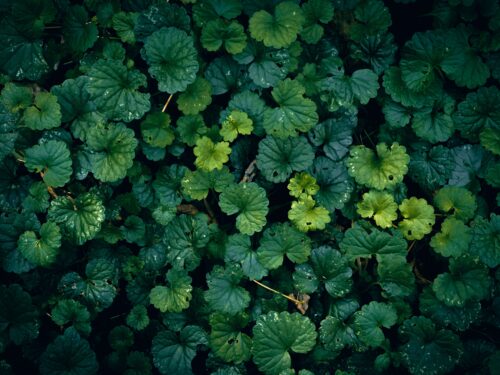
Ground Ivy is a creeping perennial belonging to the mint family. Its stems spread horizontally across the ground and produce roots wherever the nodes touch suitable soil.
This growth habit allows the plant to form extensive mats. In gardens and lawns, it is often treated as a persistent weed, but it also provides valuable early flowers for visiting insects.
The crushed leaves release a distinctive aroma that may be described as minty, resinous, peppery or slightly bitter. The flavour is much stronger than its small leaves suggest.
Ground Ivy was once widely valued as both a culinary and brewing herb. Before hops became the usual choice, it was added to ale for flavour, bitterness and clarification, giving rise to the traditional name “Alehoof”.
Ground Ivy grows as a low, creeping plant that forms spreading patches across the ground.
Its stems are square in cross-section, confirming its place within the mint family. They may be green, reddish or purplish and are often finely hairy.
The creeping stems root at their nodes. Flowering shoots turn upwards while the remaining stems continue to spread horizontally.
The leaves grow in opposite pairs along the stem. Each pair is positioned at right angles to the pair above and below it.
Individual leaves are rounded, kidney-shaped or broadly heart-shaped, with a shallow notch where the leaf stalk joins the blade.
Their edges have broad, rounded teeth or scallops. The surface may be slightly wrinkled and covered with fine hairs.
The leaves are usually 1–4 centimetres across and grow on noticeable stalks.
When crushed, they release a strong and distinctive herbal aroma.
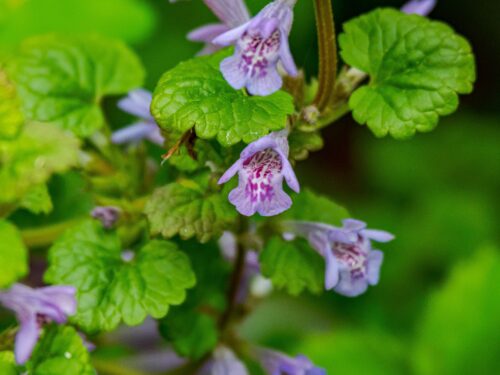
The flowers appear in small clusters from the leaf axils. They are violet-blue, lilac or occasionally pinkish and have the two-lipped shape typical of the mint family.
The lower flower lip is larger and often marked with darker purple spots. Flowers commonly appear during spring and may continue into early summer.
Use several characteristics together:
Low, creeping and mat-forming growth
Stems that root at the nodes
Square stems
Opposite pairs of rounded or kidney-shaped leaves
Broadly scalloped leaf edges
A strong aroma when the leaves are crushed
Small violet-blue, two-lipped flowers
Flower clusters growing from the leaf axils
Never identify Ground Ivy from leaf shape alone.
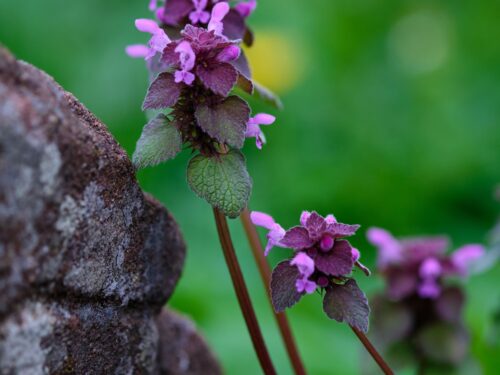
Red Dead-Nettle is another member of the mint family with square stems, opposite leaves and purple flowers.
Its upper leaves are triangular to heart-shaped and often develop a reddish or purple colour. They are more pointed and densely clustered towards the top of the stem.
Red Dead-Nettle grows upright rather than producing long creeping runners that root at the nodes.
Correctly identified Red Dead-Nettle is edible, but it should be identified separately.
Henbit has rounded, scalloped leaves and pinkish-purple flowers.
The upper leaves clasp directly around the upright stem instead of growing on long leaf stalks. Its flowers are also longer and more tubular than those of Ground Ivy.
Henbit does not normally form the same network of creeping, rooting stems.
Correctly identified Henbit is edible but should not be collected as Ground Ivy.
Bugle grows in woodland, grassland and damp shaded places and may form low spreading patches.
Its leaves are more oval or spoon-shaped and are usually less distinctly kidney-shaped. The plant produces upright flower spikes with blue or purple flowers arranged in dense whorls.
Ground Ivy flowers arise in smaller groups from the leaf axils rather than forming a compact upright spike.
Common Ivy may grow across the ground and can occur in the same shaded habitats.
It has tough, glossy, often lobed evergreen leaves growing alternately on woody climbing or trailing stems. Its leaves are not arranged in opposite pairs, and the stems are not square.
Common Ivy is not edible. Its leaves and berries should never be used as substitutes for Ground Ivy.
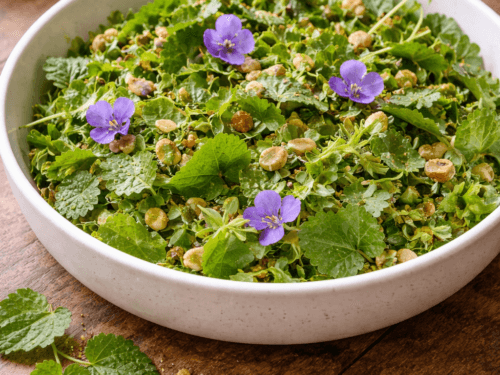
The young leaves, tender shoots and flowers of correctly identified Ground Ivy are edible in modest culinary quantities.
The plant has a strong, aromatic, slightly bitter flavour. A small amount is normally enough to flavour a complete dish or drink.
Young spring leaves are generally milder than older leaves. Taste a small piece before deciding how much to use.
Ground Ivy can be used in:
Finely chop the fresh leaves so their strong flavour is distributed evenly.
The flowers can be added as a small edible garnish. They have a milder flavour than the mature leaves but may still taste distinctly herbal.
Ground Ivy may also be dried for later use in infusions or seasoning blends. Store the fully dried herb in an airtight container away from heat, moisture and direct sunlight.
Only collect Ground Ivy after confirming its creeping, rooting stems, opposite scalloped leaves, square stem, distinctive aroma and mint-like flowers.
Use the plant in modest food-sized quantities. Its flavour is strong, and larger amounts may cause nausea, digestive irritation or other unwanted reactions.
Do not use large, concentrated or frequently repeated preparations during pregnancy or breastfeeding. Ground Ivy contains small and variable amounts of volatile compounds, including pulegone, for which concentrated exposure raises additional safety concerns.
Children and people with liver disease should not use concentrated preparations without appropriate professional guidance.
Culinary use is different from taking tinctures, essential oils, strong extracts or concentrated supplements. Research involving isolated compounds or laboratory extracts cannot be used to determine the effects of an ordinary serving of food or tea.
Ground Ivy is reported as potentially harmful to horses and some other grazing animals when consumed in substantial quantities. Do not deliberately add it to animal feed, hay or grazing mixtures.
Try only a small amount the first time. Stop using it if it causes nausea, abdominal discomfort, irritation or an allergic reaction.
Do not gather plants growing beside busy roads, on contaminated ground, from recently sprayed lawns or directly beside heavily used dog-walking routes.
Harvest only where collecting is permitted and obtain the landowner’s permission where required.
Choose healthy plants growing away from roads, sprayed lawns and other obvious sources of contamination.
Gather young leaves and tender shoot tips rather than pulling up entire rooted runners.
Take small amounts from several patches and leave plenty of flowering growth for visiting insects.
Avoid stripping all the leaves from one section of the plant.
Ground Ivy spreads readily, but dense patches still provide cover for small animals and help protect the soil.
Check the harvested material carefully for insects, damaged leaves and fragments of other low-growing plants.
Wash it thoroughly and use fresh leaves soon after harvesting.
Ground Ivy has traditionally been valued as a culinary herb, brewing ingredient and part of European rural herbal practice.
The leaves and flowering shoots were traditionally used in:
Before hops became widely used in brewing, Ground Ivy was added to ale to provide bitterness, flavour and clarification. This use gave the plant traditional names including “Alehoof” and “Gill-over-the-ground”.
Infusions of the dried herb were traditionally associated with coughs, mucus, sore throats and other seasonal respiratory complaints.
Its bitter and aromatic character also led to its traditional use in preparations associated with appetite and digestion.
External preparations were sometimes applied to irritated skin or minor wounds.
These uses form an important part of European herbal knowledge. Modern research has identified several interesting compounds in Ground Ivy, but most traditional applications have not been examined in clinical human studies.
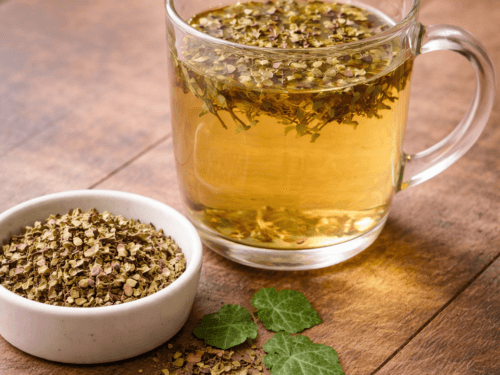
Ground Ivy contains naturally occurring polyphenols, flavonoids, tannins, terpenoids and aromatic volatile compounds.
Rosmarinic acid, chlorogenic acid, caffeic acid and related phenolic compounds have been identified in the plant.
Its flavonoids include derivatives of luteolin and apigenin. These compounds contribute to the chemical profile of the herb and have been investigated in laboratory studies.
The plant also contains triterpenes such as ursolic and oleanolic acids.
Volatile compounds contribute to the distinctive aroma and flavour of the crushed leaves. Their precise composition and concentration vary according to the plant, location, growth stage, storage and preparation method.
Ground Ivy also provides small amounts of nutrients and other normal plant constituents, including fibre, amino acids and minerals.
Laboratory findings involving isolated compounds or concentrated extracts should not automatically be applied to Ground Ivy used as an ordinary herb, food ingredient or mild infusion.
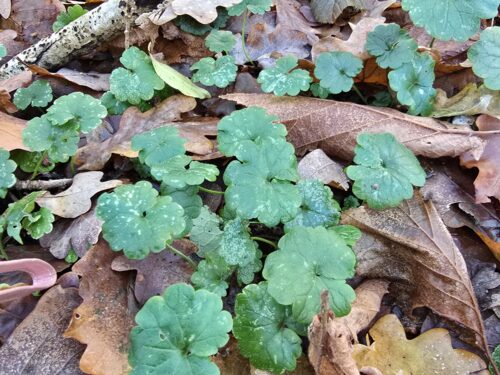
Long stems spread across the ground and produce new roots wherever their nodes touch the soil.
The small leaves release a surprisingly powerful minty, resinous and slightly bitter fragrance.
Ground Ivy was used to flavour and clarify ale before hops became the standard brewing ingredient.
Its violet-blue spring flowers provide an early seasonal food source for visiting insects.
Learn how to recognise and explore wild plants, fruits and trees safely.
Despite its name, Ground Ivy is not a true ivy. It belongs to the mint family, together with familiar herbs such as mint, thyme and rosemary.
The species name hederacea means “ivy-like” and refers to its creeping growth rather than a close botanical relationship with Common Ivy.
Its traditional name “Alehoof” recalls its historical use in brewing. “Hoof” refers to the rounded shape of the leaves, which was compared with an animal’s hoof.
Ground Ivy can produce roots at many points along its creeping stems. This allows a single plant to spread into a broad interconnected patch.
The plant often remains green during winter and may provide fresh young growth early in spring.