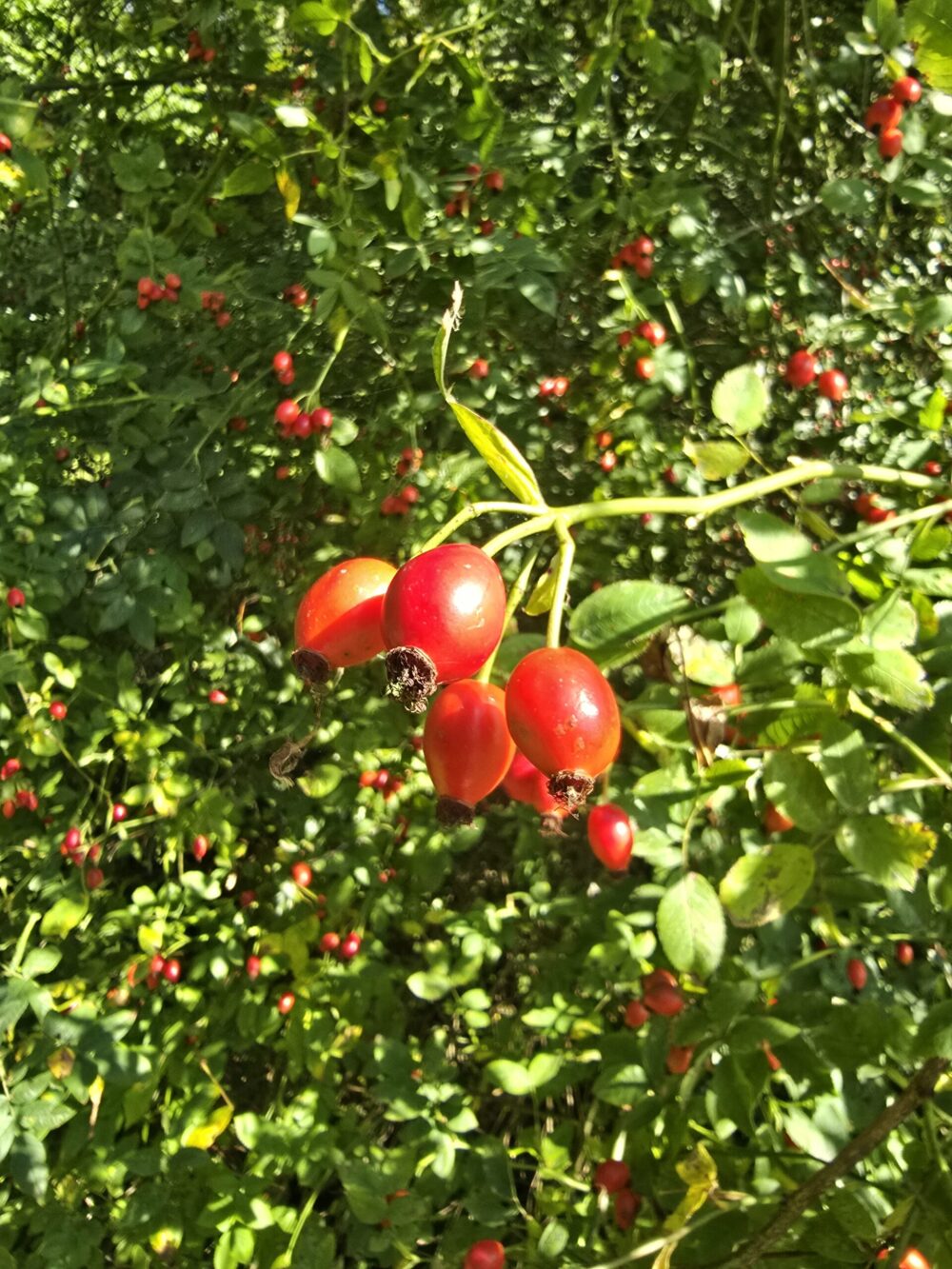
Sweet woodruff is a fragrant woodland plant with whorls of fresh green leaves and small white flowers. It is best known for its sweet scent, which becomes stronger after the plant has been allowed to wilt.
April to June, preferably shortly before or during flowering.
Shady deciduous woodland, woodland edges and other cool, moist places with humus-rich soil.
Usually 10–30 cm.
Young leaves and flowers, used only in small amounts as a flavouring.
Sweet woodruff is a low-growing perennial found mainly in shady woodland. It often forms soft green carpets beneath deciduous trees, particularly beech.
The fresh plant has only a mild fragrance. After harvesting, however, the characteristic sweet scent becomes much stronger. This aroma comes from coumarin, the compound responsible for its familiar hay-like, vanilla-like fragrance.
Sweet woodruff has traditionally been used to flavour spring drinks, syrups, desserts and preserves. Because coumarin can be harmful in excessive amounts, this plant should always be used sparingly rather than eaten as an ordinary vegetable.
Sweet woodruff is a low-growing perennial that often forms broad green carpets across the woodland floor.
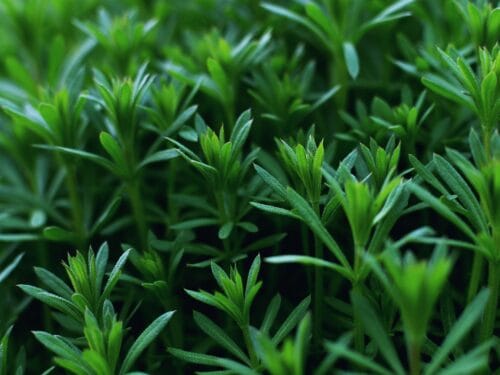
The stems are slender, square and usually unbranched. Several narrow, pointed leaves grow around each stem in distinctive whorls. Most whorls appear to contain six to eight leaves.
The leaves are bright to medium green, with smooth upper surfaces and finely rough margins. Unlike cleavers, the plant does not feel noticeably sticky and does not cling strongly to clothing.
Small white flowers appear mainly from April to June. Each flower usually has four pointed petals, creating a delicate star-like shape. The flowers grow in loose clusters near the tops of the stems.
The plant spreads through creeping underground rhizomes and may form extensive colonies in suitable shaded habitats.
Fresh sweet woodruff has only a faint scent. Its characteristic sweet fragrance becomes much stronger after the plant has wilted or dried.
Use several characteristics together: its low woodland growth, square stems, whorled leaves, four-petalled white flowers and smooth, non-sticky appearance.
Fragrance alone is never sufficient for identification.
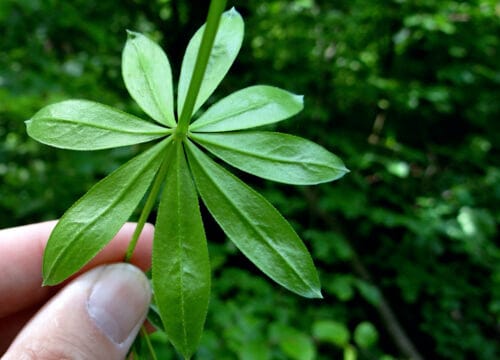
Cleavers belongs to the same botanical family and also has square stems with narrow leaves arranged in whorls.
Unlike sweet woodruff, cleavers is covered in small hooked hairs. Its leaves and stems feel rough and sticky, allowing the plant to cling to clothing, animal fur and nearby vegetation.
Cleavers normally develops longer, weaker stems that scramble through surrounding plants. Its small rounded fruits are also covered in hooked bristles.
Sweet woodruff is lower-growing, smoother and more strongly associated with shaded woodland. Its white flowers are larger and more noticeable than those of cleavers.
Several other bedstraw species may have whorled leaves, square stems and small white flowers.
The number and shape of the leaves, flower structure, stem texture, habitat and growth habit vary between species. Some bedstraws are difficult to distinguish when they are not flowering.
Confirm that the plant is specifically Galium odoratum before using it. Do not rely only on whorled leaves or a sweet scent.
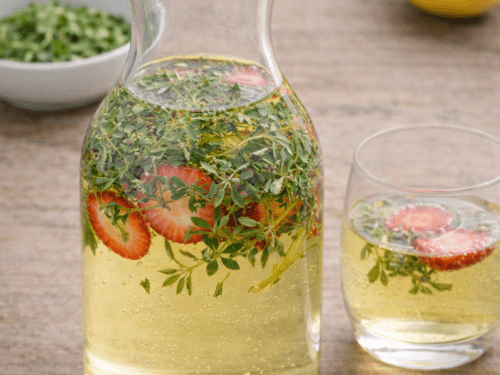
The leaves and flowers of correctly identified sweet woodruff have a history of culinary use as aromatic flavourings.
The fresh plant has a mild green flavour. When allowed to wilt briefly, it develops a sweeter fragrance reminiscent of vanilla, hay and tonka bean.
Sweet woodruff is traditionally used in:
May wine and spring punch
Flavoured syrups and cordials
Apple juice or white grape juice
Jellies and desserts
Custards and creams
Flavoured sugar
Herbal honeys
Small culinary infusions
The stems are normally infused and then removed rather than eaten as a vegetable.
Use only a small amount to flavour an entire preparation. Sweet woodruff is not suitable as a salad leaf, cooked vegetable, strong herbal tea or everyday tonic.
The roots and rhizomes should not be harvested or used as culinary ingredients.
Sweet woodruff naturally contains coumarin-related compounds. Coumarin creates the plant’s characteristic fragrance but may harm the liver when consumed in excessive quantities or repeatedly over time.
Use sweet woodruff only occasionally and in small amounts. Avoid strong, concentrated or long-infused preparations.
Do not assume that drying makes the plant safer. Wilting and drying strengthen the fragrance but do not remove the need to limit the amount used.
Avoid consuming sweet woodruff every day or combining several sweet woodruff preparations within a short period.
Children have a lower body weight and may reach an unsafe intake more quickly than adults. Concentrated preparations are not suitable for children.
The safety of sweet woodruff during pregnancy and breastfeeding has not been adequately established. People who are pregnant or breastfeeding, have liver disease, take medication or have another medical condition should seek advice from an appropriately qualified healthcare professional before using it.
Stop consuming the preparation if nausea, dizziness, headaches or other unexpected symptoms occur.
Sweet woodruff should not be promoted as a treatment for anxiety, insomnia, digestive problems or any other medical condition.
Harvest only where collecting wild plants is permitted and obtain the landowner’s permission where required.
Cut a small number of healthy upper stems with clean scissors rather than pulling up the complete plant.
Do not dig up the roots or rhizomes. These underground parts allow the colony to survive and continue spreading.
Take only a small amount from a large, healthy patch. Because very little sweet woodruff is required for flavouring, there is no need to gather large bundles.
Avoid trampling surrounding woodland vegetation or disturbing the soil.
Do not harvest beside busy roads, polluted water, industrial land, sprayed fields or places frequently visited by dogs.
Leave small or isolated populations untouched.
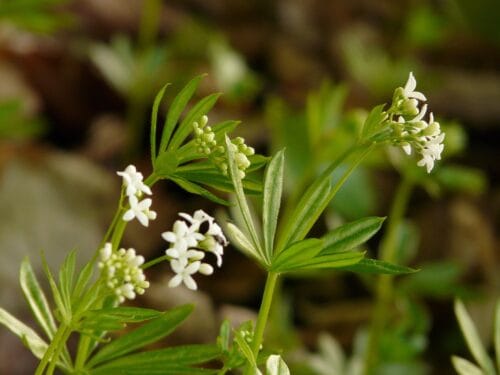
Sweet woodruff has traditionally been valued for its sweet woodland fragrance and its association with spring.
In European traditions, the leaves and flowering stems were used in:
Historical herbal traditions associated sweet woodruff with rest, digestion and sleep. These traditional uses reflect knowledge and practices passed down through generations. Although not every historical application has been confirmed by modern clinical research, this heritage remains an important part of understanding how the plant was valued and used.
Because sweet woodruff contains coumarin, traditional use should still be approached carefully. Strong, concentrated or frequently repeated preparations are not recommended without guidance from an appropriately qualified herbal or healthcare professional.
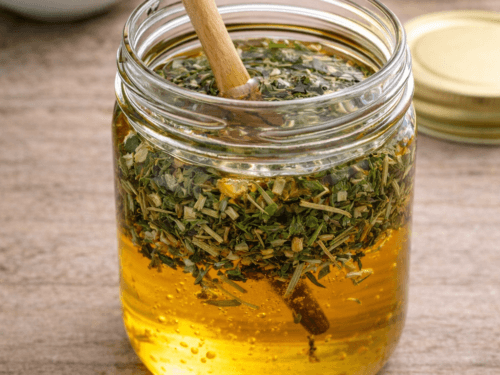
Sweet woodruff contains naturally occurring aromatic compounds that contribute to its characteristic fragrance.
The fresh plant contains compounds that release coumarin as the plant tissue wilts or dries. This is why freshly harvested sweet woodruff may have very little scent, while wilted stems smell noticeably sweeter.
The amount of coumarin can vary depending on the plant, growing conditions, harvest time and preparation method.
Sweet woodruff also contains smaller amounts of phenolic compounds, flavonoids and other naturally occurring plant substances.
The presence of these compounds does not by itself demonstrate a medicinal effect.
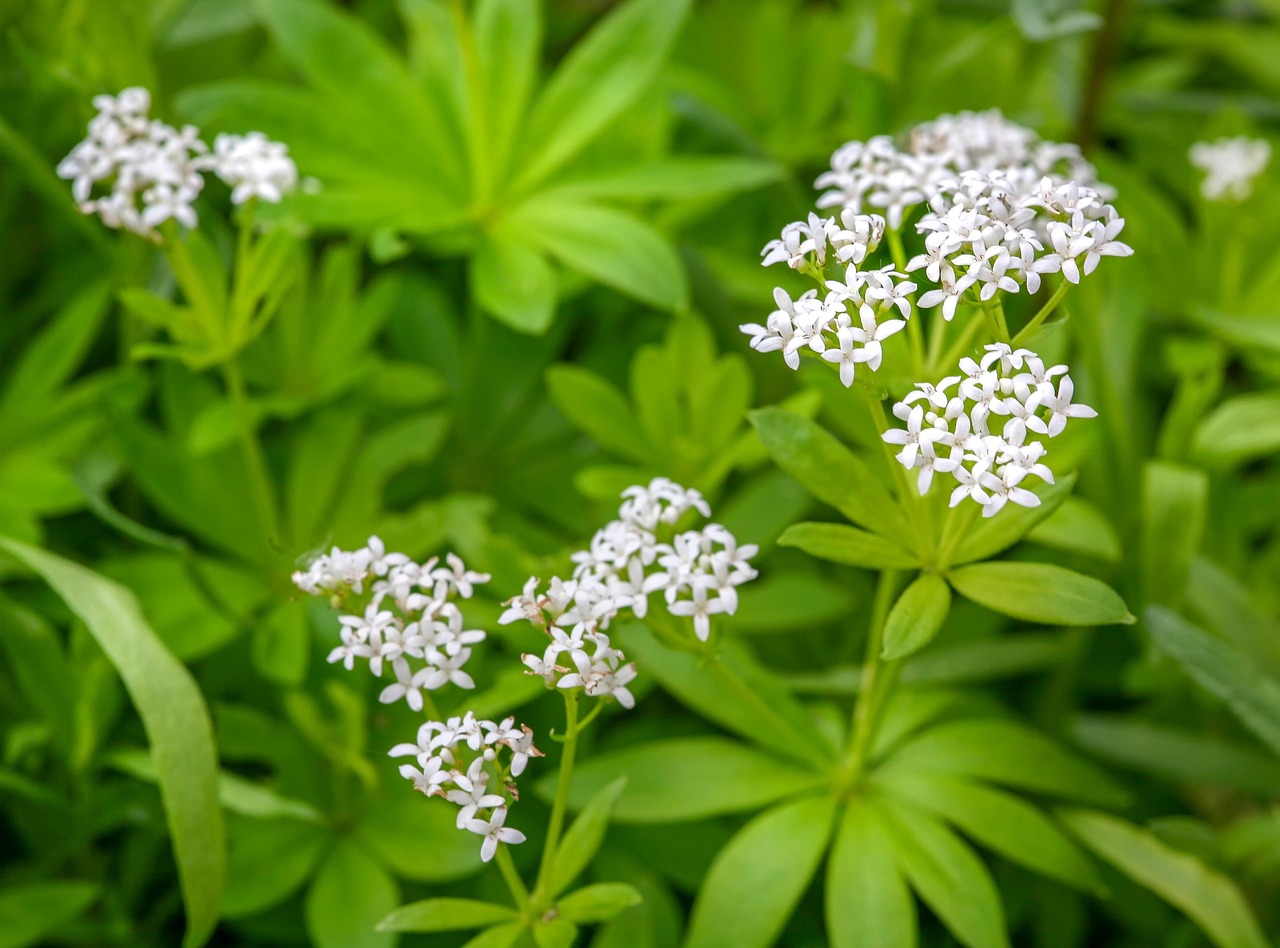
Narrow green leaves form distinctive rings around the square stems
The sweet hay-like aroma becomes stronger after the plant has wilted
Small white flowers with four pointed petals appear in spring
Creeping rhizomes allow the plant to form extensive patches in shaded woodland
Sweet woodruff may smell surprisingly mild when it is first picked.
Its familiar sweet fragrance develops as the stems begin to wilt and natural compounds in the plant release coumarin.
This means that the aroma may become much stronger after harvesting. A stronger scent does not mean that more of the plant should be used — with sweet woodruff, a small amount is enough.