A tall evergreen conifer with paired blue-green needles, small woody cones and distinctive orange-red bark on the upper trunk.
Scots pine has long been valued for its fragrant needles, young shoots, resin and wood. Correctly identified needles and young spring shoots can be used sparingly to flavour teas, syrups and other seasonal preparations.
Needles: all year round
Young shoots: spring, before they harden
Woodlands, heathlands, dunes and sandy or nutrient-poor soils; also widely planted in forests and parks
Usually 15–35 metres when mature
Needles and young spring shoots — only after certain identification
Scots pine is an evergreen conifer found across a broad area of Europe and Asia. It is widely planted in forests and grows particularly well on sandy, acidic and nutrient-poor soils.
Mature trees are recognisable by their tall trunks, irregular open crowns and warm orange-red bark on the upper trunk and branches. The lower bark becomes thicker, greyer and more deeply fissured with age.
Its fragrant needles and young shoots have traditionally been used to flavour seasonal drinks, syrups and infusions. Identification must always be certain because several evergreen trees have needle-like leaves, including the highly poisonous yew.
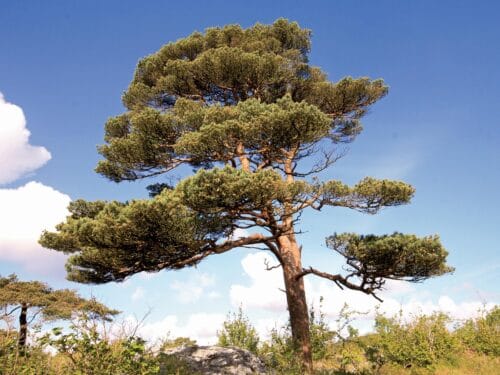
Scots pine is a tall evergreen tree that often develops an open, irregular crown as it matures.
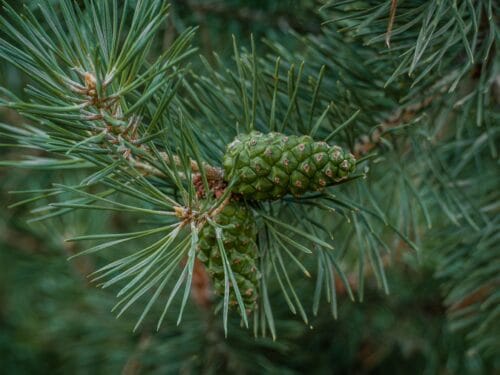
The needles grow in bundles of two. Each pair is enclosed at its base by a small papery sheath.
The needles are usually around 4–7 centimetres long. They are blue-green to grey-green, slightly twisted and relatively stiff.
Young bark is grey-brown. On mature trees, the upper trunk and branches develop distinctive flaky orange, copper or reddish bark. The lower trunk is usually darker, thicker and more deeply cracked.
The cones are small, woody and broadly egg-shaped, usually around 3–7 centimetres long. Young cones are green before maturing to grey-brown. Each cone scale has a raised central bump but no long projecting spike.
Male pollen cones appear as clusters of small yellow structures in spring. Female cones begin reddish before becoming green and eventually woody brown.
Use several features together: paired needles, their size and colour, the orange upper bark, the form of the cones and the overall shape of the tree.
Scent alone is never sufficient for identification.
Highly poisonous and potentially fatal
Yew is the most important dangerous conifer to exclude. Never make tea, syrup, oil or food from an unidentified evergreen tree.
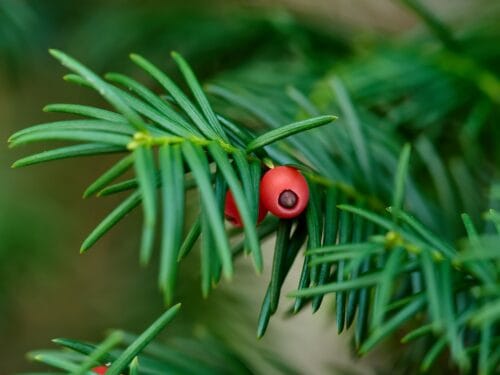
Unlike Scots pine, yew needles grow individually, not in bundles of two. They are flat, dark green, relatively soft and often appear arranged in two rows along the twig.
Yew does not produce woody pine cones. Female trees develop red, fleshy cup-like structures around a single seed.
Almost every part of yew is highly poisonous, including the needles, bark and seeds. Although the red flesh surrounding the seed is not itself poisonous, the seed inside is toxic and should never be eaten.
Never taste a conifer as an identification test. If you cannot clearly confirm paired needles and the other characteristics of Scots pine, do not harvest it.
Spruces, firs and other pine species may also be confused with Scots pine.
Spruce needles grow individually and are attached to small woody pegs. Fir needles also grow individually and are generally flatter and softer.
Some other pine species also have needles in bundles, but the number, length and stiffness can differ. Confirm that the tree is specifically Pinus sylvestris before using it.
Do not use needles from unidentified ornamental conifers, treated Christmas trees or decorative branches.
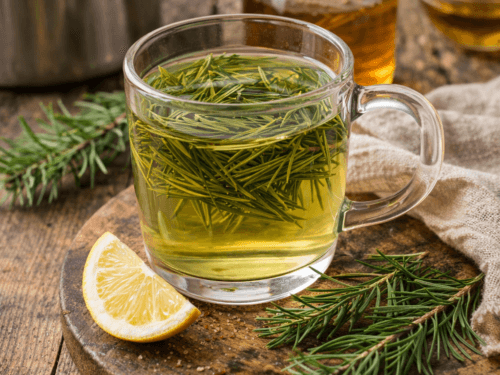
The needles and soft young shoots of correctly identified Pinus sylvestris have a history of culinary use as aromatic flavourings.
The needles have a fresh, resinous and slightly citrus-like flavour. Because their texture is tough, they are normally infused and removed rather than eaten whole.
Young spring shoots are softer and milder. They can be infused in sugar or honey to create a fragrant seasonal syrup. Harvest them very sparingly because removing shoots affects the tree’s growth.
Scots pine is traditionally used in:
Pine-needle infusions
Flavoured syrups
Herbal honeys
Vinegars
Salt or sugar blends
Jellies
Seasonal drinks
Culinary infusions
Aromatic oils for external use
Use modest amounts. The strong resinous flavour can quickly become overpowering.
Harvest only where collecting is permitted and obtain the landowner’s permission where required.
Take a small number of healthy needles or side shoots from several established trees rather than stripping one branch.
Never remove the main upright leader at the top of a young tree. Removing it can permanently distort the tree’s growth.
Avoid damaging the bark, breaking large branches or collecting excessive amounts of resin.
Leave young trees and ecologically sensitive woodland untouched.
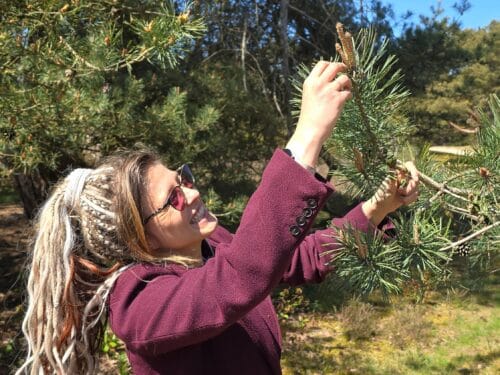
Scots pine has traditionally been valued for its clean, resinous fragrance and its association with winter woodland.
In European traditions, the needles, young shoots and resin were used in:
Pine preparations were commonly associated with breathing comfort, warmth and winter wellbeing. These uses are based on traditional practice and do not prove that Scots pine can prevent, treat or cure respiratory infections or other medical conditions.
Medicinal preparations and concentrated extracts should only be used with appropriate professional guidance.

Scots pine needles and young shoots contain aromatic volatile compounds that create their characteristic fresh, resinous scent.
These include different terpenes, such as alpha-pinene, beta-pinene and limonene. Their exact proportions vary depending on the tree, growing conditions, season and plant part.
The needles also contain resins, phenolic compounds, pigments and naturally occurring antioxidants.
Fresh needles may contain vitamin C, but the amount is highly variable and can be affected by storage and preparation. Pine-needle tea should not be presented as a reliable substitute for normal dietary sources of vitamin C.
The presence of these compounds does not by itself demonstrate a medicinal effect.
Blue-green needles grow in distinctive bundles of two
Mature trees develop warm orange-red bark high on the trunk
The tree keeps its needles and colour throughout winter
Scots pine can thrive on sandy, acidic and nutrient-poor soils
Scots pine can look very different as it matures.
Young trees often have a neat, conical shape. Older trees may develop tall bare trunks and broad, irregular crowns shaped by wind, weather and growing conditions.
The warm orange bark on the upper trunk becomes especially striking in sunlight and is one of the tree’s most useful identification features.