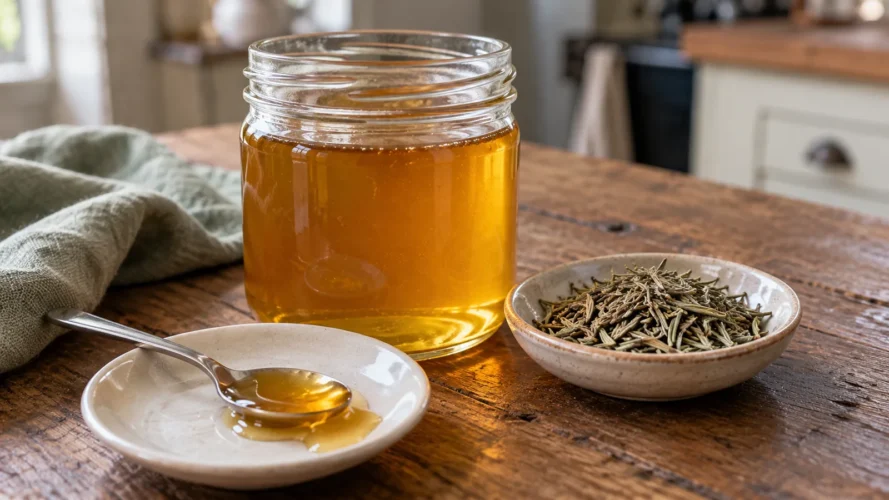
Ingredients
Equipment
Method
- Check that the rosemary leaves are fully dried, crisp and brittle. Use a clean jar and utensils that are completely dry.
- Lightly crush the rosemary leaves between your fingers and place them in the jar.
- Add the honey and stir with a dry spoon to distribute the leaves. Close the lid tightly.
- Leave in a cool, dark cupboard. Turn the sealed jar over periodically to redistribute the rosemary, then return it upright.
- Taste after 14 days using a clean, dry spoon. If you prefer a stronger flavour, continue infusing and check every few days. Flavour development may take several weeks.
- Pour through a clean, dry fine-mesh sieve into a dry bowl or jug. Allow time for the thick honey to drain, then transfer to a clean, dry storage jar. Close and label with the preparation date.
Notes
Dried rosemary only: This method requires fully dried culinary leaves. Fresh rosemary is not a direct substitute. Do not add fresh citrus peel, ginger, water or juice to the storage jar.
Honey choice: A mild honey allows the rosemary flavour to stand out. Raw honey is optional; ordinary runny honey also works.
Infusion time: Fourteen days is a starting point for tasting, not a guaranteed finishing time. The rosemary, honey and room temperature affect how quickly the flavour develops.
Straining: Fine particles may pass through a sieve. For a clearer result, use a finer food-safe filter suitable for thick liquids, ensuring all equipment is clean and dry.
Yield: Approximately 230–250 g after straining, depending on how much honey remains with the herbs and sieve. This is an estimate.
Storage: Keep tightly sealed in a cool, dark, dry place. Always use a clean, dry spoon and prevent water from entering the jar. These instructions apply only to honey prepared with fully dried ingredients.
Spoilage: Discard honey that develops mould, unexplained ongoing bubbling or a sour or fermented smell. Crystallisation alone is a normal change in honey.
Serving: Start with a small spoonful and adjust to taste. This is a flavoured food, not a medicinal dosage.
Citrus variation: Add a little freshly grated lemon or orange zest to your individual serving just before eating, rather than to the storage jar.
Infants: Do not give honey, including infused honey, to children under 12 months.
Allergies: Avoid this preparation if you are allergic to rosemary, honey or any ingredients used.