A distinctive autumn and winter mushroom with a sturdy build and beautiful violet, lilac and brownish colouring.
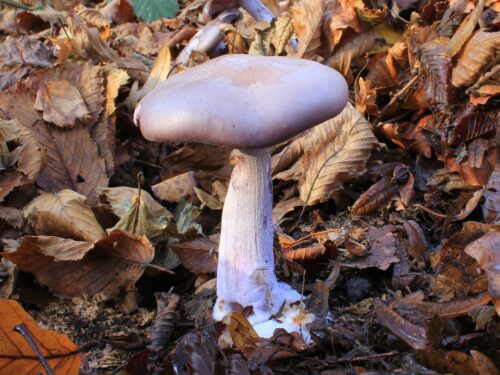
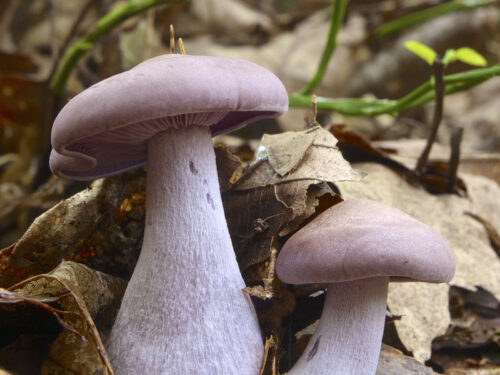
Young Wood Blewits have lilac caps, crowded violet gills and pale purple stems. Their colours fade considerably with age, making careful identification and a pale pinkish spore print especially important.
Late summer to early winter, most commonly from September to December
Fruit bodies may continue appearing during mild winter weather
Leaf litter in deciduous, coniferous and mixed woodland, beneath hedgerows, in parks, gardens, orchards and occasionally on old compost heaps
Caps commonly 6–15 centimetres across
Stems usually 5–10 centimetres tall and 1.5–2.5 centimetres thick
The caps and firm stems of young, healthy and confidently identified specimens, cooked thoroughly before eating
Wood Blewits are saprotrophic fungi. They obtain nutrients by breaking down fallen leaves and other decaying organic material.
They may grow individually, in small groups or in broad arcs and rings. These so-called fairy rings can gradually expand as the underground mycelium grows through suitable soil and leaf litter.
Their violet colouring is most noticeable in young specimens. Mature Wood Blewits can fade to buff, tan or brownish shades, although traces of lilac often remain on the gills or stem.
Wood Blewits are valued as late-season mushrooms because they can continue fruiting after many other familiar edible species have disappeared.
Wood Blewits are sturdy, fleshy mushrooms that grow on the ground among leaf litter and decaying plant material.
Young caps are convex with an inrolled margin. They gradually flatten and may develop a wavy edge. Their colour ranges from violet and lilac-purple to pinkish-brown, buff or tan as they age.
The smooth cap may feel slightly greasy when damp but should not have scales, prominent warts or cobweb-like veil remnants.
The gills are crowded and attached to the stem. They begin lilac or violet and gradually fade to pinkish-buff. The solid, sturdy stem is usually pale purple or lilac when young and may become slightly swollen towards the base.
Wood Blewits have no ring, cup or cobweb-like cortina. Their flesh is thick and pale, with a distinctive fragrance often described as floral, fruity or faintly reminiscent of aniseed.
Colour alone is never sufficient for identification. A confident identification should combine:
A sturdy, fleshy build
A smooth cap with an inrolled margin when young
Crowded lilac or violet gills
A solid lilac or pale purple stem
No ring, cup or cobweb-like cortina
A pleasant, perfumed or fruity fragrance
Growth in leaf litter or other decaying organic material
A pale pinkish-buff spore print
To make a spore print, place a mature cap with its gills facing downwards on both white and dark paper. Cover it and leave it undisturbed for several hours.
A Wood Blewit should produce a pale pink, pinkish-buff or very pale flesh-coloured spore deposit. A rusty or distinctly brown spore print indicates a different fungus and must not be accepted as Wood Blewit.
Never identify a Wood Blewit from its purple colour or from a photograph alone.
Several webcaps have violet caps, gills and stems and may grow in the same woodland habitats as Wood Blewits.
Young specimens may have a cobweb-like cortina between the cap and stem. As they mature, their gills and stems often develop rusty-brown staining, and their spore print is rust-brown rather than pale pinkish-buff.
Some Cortinarius species are dangerously poisonous. Never eat a suspected Wood Blewit with rusty deposits, a brown spore print or cobweb-like veil remnants.
This poisonous mushroom is normally smaller and more slender than a Wood Blewit. It has a conical, fibrous cap that often retains a pointed central bump.
Its gills change from pale grey or cream to clay-brown, and its spore print is dull brown. Never collect small, pointed or distinctly fibrous lilac mushrooms as Wood Blewits.
Field Blewits usually grow in grassland rather than woodland leaf litter. Their caps are commonly cream, buff or grey-brown, while the sturdy stem retains a strong blue-purple colour.
They have similar culinary uses when correctly identified but should be identified independently.
Amethyst Deceivers are smaller and more slender, with widely spaced, thick gills and a long fibrous stem.
Their spore print is white rather than pale pinkish-buff. Older specimens can fade considerably, so colour alone is unreliable.
Sordid Blewits are generally smaller, thinner and less fleshy than Wood Blewits, although the two can look very similar.
Do not rely on size or colour alone when distinguishing closely related blewit species.

Wood Blewits are edible only after confident identification and thorough cooking.
Use young, healthy specimens with firm flesh. Older mushrooms may become soft, waterlogged, insect-damaged or faded beyond reliable identification.
Discard specimens with mould, extensive insect tunnels, unpleasant odours, slimy decomposition or unexplained discolouration.
Wood Blewits must not be eaten raw. Cook them thoroughly until hot throughout.
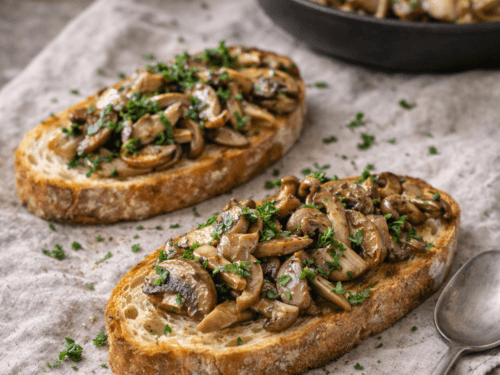
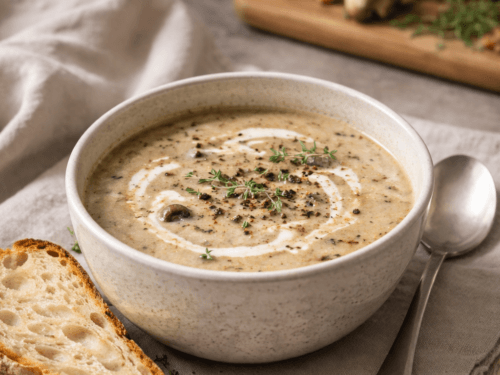
Their flavour is savoury and aromatic, sometimes with a slightly sweet, floral or peppery quality. The texture is soft but pleasantly fleshy when young.
Wood Blewits can be used in:
Sautéed mushroom dishes
Creamy sauces
Soups and stews
Risottos
Pasta dishes
Omelettes
Savoury pies
Mixed mushroom dishes
The mushrooms release moisture during cooking. Beginning in a wide pan allows excess liquid to evaporate before butter, herbs, cream or other ingredients are added.
Some people experience digestive discomfort even after the mushrooms have been cooked correctly. Try only a small portion the first time and do not combine several unfamiliar wild mushroom species in the same meal.
Refrigerate freshly collected mushrooms and use them promptly. Do not store wet or damaged specimens.
Never identify a Wood Blewit from its violet colour alone. Several purple mushrooms are poisonous or potentially dangerous.
Check carefully for webcaps from the genus Cortinarius. Cobweb-like veil remnants, rusty staining or a rust-brown spore print mean the mushroom is not a Wood Blewit. Also avoid small mushrooms with a pointed, fibrous cap and brown mature gills, which may be poisonous fibrecaps.
A Wood Blewit should have a pale pinkish-buff spore print. It must never be eaten raw or undercooked. Cook thoroughly and try only a small portion the first time, as some people experience digestive discomfort.
Never rely on an app, photograph or single characteristic. If identification remains uncertain, leave the mushroom where it is or have it examined in person by an experienced mushroom identifier.
If illness develops after eating any wild mushroom, seek urgent medical advice. Keep an uncooked specimen and any leftovers when safe.
Harvest only where collecting is permitted and obtain the landowner’s permission where required.
Choose fresh, healthy fruiting bodies growing away from obvious sources of pollution.
Take only the quantity you can identify, prepare and use while it remains fresh.
Cut or gently twist individual mushrooms without unnecessarily disturbing the surrounding leaf litter and soil.
Leave very young, overmature and damaged specimens in place. They remain part of the woodland ecosystem and may release spores.
Avoid raking through leaf litter or damaging the underground mycelium while searching for additional mushrooms.
Wood Blewits may grow in arcs or fairy rings. Do not remove every mushroom from a productive group.
Protect the surrounding habitat and avoid disturbing mosses, plants, insects and woodland wildlife.
Wood Blewits have traditionally been valued as late-season food mushrooms in several parts of Europe.
They were traditionally used in:
Their ability to appear during cold autumn and early-winter weather made them especially useful after many other edible mushrooms had disappeared.
Wood Blewits have been sold in markets and shops in parts of Europe, particularly in France, Spain and Portugal. Both Wood Blewits and Field Blewits may be sold under names such as “pied bleu”, meaning blue foot.
Fairy rings formed by Wood Blewits also became associated with traditional European stories about fairies, spirits and unexplained circles appearing in fields and woodland.
The fungus has additionally been used to produce green dyes for fabric or paper. This unexpected colour differs considerably from the violet appearance of the fresh mushroom.
Traditional culinary use does not remove the need for modern identification. Purple mushrooms should never be eaten solely because they resemble descriptions from folklore, books or markets.
Wood Blewits contain water, protein, carbohydrates, dietary fibre and small amounts of fat.
Like other edible fungi, they contain fungal polysaccharides and sterols, including ergosterol, a precursor of vitamin D₂.
Phenolic compounds and other naturally occurring substances have been detected in laboratory extracts. Their composition varies with maturity, habitat, storage and preparation.
Wild fungi can also accumulate undesirable substances from their surroundings. This is why mushrooms collected beside busy roads or from contaminated soil should not be eaten.
Laboratory research involving isolated compounds does not demonstrate that eating Wood Blewits can prevent or treat disease. They should be regarded as seasonal food rather than medicine.
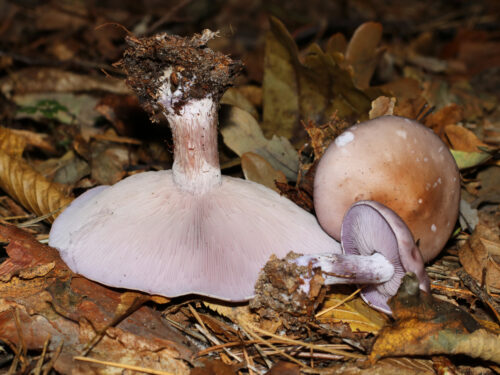
Young specimens display striking lilac colouring across the cap, crowded gills and sturdy stem.
The pale pinkish-buff spore deposit helps separate Wood Blewits from rusty-spored webcaps.
Wood Blewits can continue appearing during late autumn and mild winter weather.
Groups may form broad arcs or rings as the underground mycelium expands through leaf litter.
Learn how to recognise and explore wild plants, fruits, fungi and trees safely.
The name “blewit” is thought to refer to the mushroom’s distinctive bluish-purple or lilac colouring.
Young Wood Blewits are often strongly violet, but their colour can fade considerably with age. Older specimens may become pale lilac, pinkish-brown or buff, making colour alone unreliable for identification.
Wood Blewits grow on decaying leaves and other organic material. They help recycle nutrients and may appear in groups, arcs or broad fairy rings in woodland, gardens and compost-rich places.
The species has long been known as Lepista nuda and has also been classified as Clitocybe nuda. Following more recent taxonomic research, it is now placed in the genus Collybia as Collybia nuda. All three names may therefore appear in books, websites and identification guides.
Wood Blewits have also been commercially cultivated, although they remain best known as distinctive late-autumn and early-winter wild mushrooms.